
Mitsubishi ac compressor change becomes necessary when the vehicle’s air-conditioning system can no longer produce consistent cooling because the compressor is worn, damaged, seized, or internally contaminated. In Dubai, a properly functioning car AC system is more than a comfort feature. With high outdoor temperatures and frequent traffic, drivers depend on reliable cabin cooling throughout the year.
The AC compressor is often described as the heart of the vehicle’s air-conditioning system because it circulates refrigerant between the major AC components. When it develops a fault, simply adding refrigerant may provide temporary improvement but will not solve the underlying problem. A failing compressor can also place additional strain on other components, especially if it is producing metal debris or operating with insufficient lubrication.
For Mitsubishi owners, accurate diagnosis is therefore important before replacing an expensive component. Different models can have different compressor designs and AC system requirements, so the correct replacement procedure depends on the vehicle, compressor type, refrigerant specification, and condition of the rest of the system.
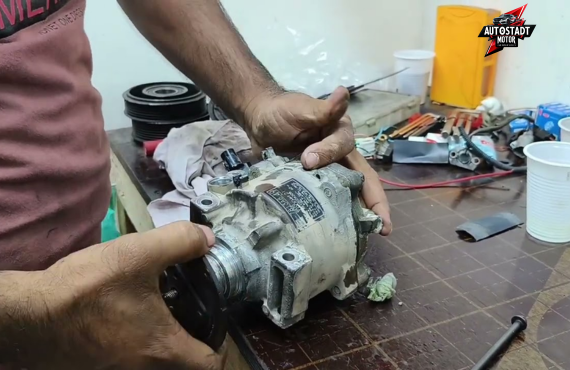
At AutoStadt Motor Services, Mitsubishi AC problems are approached through inspection, diagnosis, component testing and professional replacement rather than unnecessary parts changing. Whether you drive a Mitsubishi Pajero, Outlander, ASX, Lancer, or another model, the goal is to restore dependable cooling while identifying the reason the original compressor failed.
Signs Your Car Needs Mitsubishi AC Compressor Change
Weak Cooling From the Air Vents
One of the most noticeable warning signs is air that remains warm or only slightly cool even when the AC is set to its lowest temperature. A refrigerant issue, blocked condenser, faulty expansion valve, or compressor problem can all produce similar symptoms.
However, if refrigerant pressures are abnormal and the compressor is not compressing the refrigerant correctly, a Mitsubishi ac compressor change may be required.
AC Takes Too Long to Cool the Cabin
Your Mitsubishi may still produce some cold air, but the cabin takes an unusually long time to become comfortable. This can happen when the compressor has lost efficiency.
In Dubai, this problem can become particularly noticeable after the vehicle has been parked outside. A healthy AC system should progressively reduce cabin temperature rather than struggling continuously.
Unusual Noise When the AC Is Switched On
A damaged compressor pulley, bearing, clutch, or internal compressor component may create clicking, grinding, whining, or rattling noises.
Pay attention to whether the sound appears or becomes louder when the AC is activated. That change can help technicians identify whether the compressor or another accessory drive component is responsible.
Compressor Clutch Does Not Engage
On Mitsubishi models equipped with a conventional compressor clutch, the clutch should engage when the AC system requests compressor operation. If it does not, the cause could be electrical rather than mechanical.
A technician should therefore check the fuse, relay, wiring, pressure switch or sensor, control system, and compressor itself before recommending replacement.
Refrigerant Leaks Keep Returning
Repeated refrigerant refills are a warning that something is wrong. Refrigerant should circulate inside a sealed system. If the system repeatedly loses refrigerant, there may be a leak around hoses, connections, seals, the condenser, evaporator, or compressor.
Replacing the compressor without identifying a separate leak can result in another AC problem later.
Oil or Refrigerant Residue Around the Compressor
Compressor oil mixed with dirt can sometimes appear around leaking seals or connections. This should not automatically be treated as proof that the compressor itself has failed, but it is an important inspection point.
A professional technician can determine whether the compressor, seal, hose connection, or another AC component is responsible.
AC Performance Changes With Engine Speed
A weak or mechanically damaged compressor may struggle to maintain proper cooling under different operating conditions. If the AC works somewhat better while driving but becomes weak during idling, several possible causes need to be investigated.
The condenser fan, refrigerant charge, compressor efficiency, airflow and engine operating conditions can all affect performance.
Why Choose AutoStadt Motor Services for Mitsubishi AC Compressor Change
Choosing the correct workshop is important because compressor replacement is not simply a matter of removing one part and installing another. The entire AC circuit should be considered.
Accurate AC System Diagnosis
At AutoStadt Motor Services, the process starts with diagnosis rather than immediately replacing the compressor. Technicians can assess cooling performance, refrigerant pressures, compressor operation, electrical signals and other relevant components.
This approach helps distinguish a genuinely failed compressor from problems such as low refrigerant, a faulty expansion valve, condenser airflow problems or electrical faults.
Correct Compressor Selection
A Mitsubishi compressor should match the vehicle’s specific requirements. Using an unsuitable component can affect cooling performance and reliability.
The correct part should be selected according to the Mitsubishi model, year, engine configuration and AC system specifications. Where applicable, technicians can also inspect the existing compressor and compare the replacement component before installation.
Professional Installation
During a Mitsubishi ac compressor change, proper installation is essential. The system may need to be evacuated, inspected, correctly lubricated and recharged according to the manufacturer’s specifications.
Improper installation can introduce moisture or contaminants into the AC circuit and potentially shorten the life of the replacement compressor.
Attention to the Complete AC System
A compressor does not work independently. It operates with the condenser, evaporator, expansion device, refrigerant, compressor oil, hoses, pressure controls and electrical components.
For example, if a Mitsubishi compressor fails internally and sends debris through the system, installing another compressor without addressing contamination can create further problems. This is why a complete system assessment matters.
Experience With Different Vehicle AC Systems
AutoStadt Motor Services works with a range of vehicle systems, allowing technicians to approach Mitsubishi AC problems with broader automotive experience. Similar diagnostic principles are useful when dealing with vehicles such as a Toyota Land Cruiser, Nissan Patrol, BMW X5, or Mercedes-Benz E-Class, even though their components and control systems differ.
The objective is always to diagnose the actual fault rather than assume that every AC problem requires the same repair.
How Our Mitsubishi AC Compressor Change Process Works
Step 1: Initial AC Inspection
The process begins with an assessment of the complaint. Technicians check the cooling performance and listen for unusual sounds when the AC is operating.
The vehicle’s model and AC configuration are also considered before further testing.
Step 2: Compressor and System Diagnosis
The compressor is inspected along with relevant AC components. Depending on the symptoms, technicians may check refrigerant pressure, compressor engagement, electrical signals, condenser operation, cooling fans and other components.
This stage is important because poor cooling does not automatically mean the compressor needs replacement.
Step 3: Identify the Cause of Failure
Before fitting a new compressor, the reason for the original failure should be investigated.
Possible causes include inadequate lubrication, refrigerant loss, electrical faults, excessive system pressure, component wear, contamination or general compressor deterioration.
Finding the cause helps reduce the possibility of damaging the replacement component.
Step 4: Recover the Existing Refrigerant
If compressor replacement is confirmed, the existing refrigerant is handled using appropriate AC service procedures rather than simply releasing it.
The system is then prepared for component replacement.
Step 5: Remove the Faulty Compressor
The old compressor is carefully removed from the vehicle. Connected components, mounting points, pipes, electrical connections and related seals are inspected during this stage.
If contamination or unusual debris is discovered, additional AC system service may be necessary.
Step 6: Install the Replacement Compressor
The replacement Mitsubishi compressor is installed according to the vehicle’s requirements. Appropriate seals, compressor oil and installation procedures are used as required.
The connected AC components are then checked to ensure there are no obvious installation issues.
Step 7: Vacuum and Leak Testing
After the repair, the AC system needs to be properly evacuated before the correct refrigerant charge is introduced. Vacuum testing also helps identify certain system integrity issues.
This step is especially important because moisture and air inside the system can affect AC operation.
Step 8: Correct Refrigerant Recharge
The system is recharged using the appropriate refrigerant and quantity specified for the vehicle.
Overcharging and undercharging can both affect cooling performance, so accurate charging is important rather than simply adding refrigerant until the AC “feels cold.”
Step 9: Final Performance Testing
Finally, the AC is tested under operating conditions. Technicians check cooling performance, compressor operation, airflow, abnormal noises and system pressures.
The aim is to make sure the repair addresses the original complaint and that the AC system is operating normally before the vehicle is returned.
Frequently Asked Questions About Mitsubishi AC Compressor Change in Dubai
1. How do I know if my Mitsubishi AC compressor really needs replacement?
Weak cooling alone does not prove that the compressor has failed. Similar symptoms can be caused by low refrigerant, leaks, electrical faults, condenser problems, expansion valve issues or cooling fan failures.
A proper diagnosis should therefore be performed before replacing the compressor. At AutoStadt Motor Services, the AC system can be inspected to determine whether the compressor is actually responsible for the problem.
2. How long does a Mitsubishi AC compressor change take?
The time depends on the Mitsubishi model, compressor accessibility and the condition of the AC system. A straightforward compressor replacement may take several hours, while additional work can increase the service time.
If contamination, refrigerant leakage or another failed component is discovered, technicians may need to perform additional procedures before the AC system can be correctly restored.
3. Can I just refill the AC gas instead of changing the compressor?
If the compressor is mechanically healthy and the problem is simply low refrigerant caused by a leak, a refill combined with leak repair may solve the issue.
However, if the compressor is damaged, seized or unable to create the required pressure, adding refrigerant will not repair it. Repeatedly refilling refrigerant without diagnosing the underlying fault can also lead to unnecessary expense.
4. Is compressor replacement different for every Mitsubishi model?
Yes. Mitsubishi vehicles use different AC configurations depending on the model, production year and engine. A Pajero, Outlander, ASX and Lancer, for example, may not use identical compressor components or system specifications.
For this reason, the vehicle’s exact details should be confirmed before selecting a replacement compressor and carrying out the repair.
5. How can I prevent another AC compressor failure?
Regular AC inspection can help identify problems before they become major failures. Pay attention to weak cooling, unusual compressor noises, repeated refrigerant loss and changes in AC performance.
It is also important to address leaks instead of repeatedly topping up refrigerant. Keeping the condenser area clean, ensuring adequate cooling-fan operation and having the AC system checked when performance changes can also help protect the system.
Conclusion
Mitsubishi ac compressor change can restore reliable cabin cooling when the compressor has suffered mechanical or internal failure. However, the most important part of the repair is not simply installing a new component. Correct diagnosis, identifying the cause of failure, inspecting the surrounding AC system, using the appropriate compressor and completing proper vacuum and refrigerant procedures all contribute to a dependable repair.
For Dubai drivers, a functioning AC system is essential for comfortable everyday driving, particularly during long commutes and periods of extreme outdoor heat. Ignoring unusual noises, weak cooling or repeated refrigerant loss can allow a relatively manageable AC issue to develop into a more complicated repair.
AutoStadt Motor Services provides Mitsubishi AC diagnosis, compressor replacement and related car AC services in Dubai with a focus on proper testing and practical repair solutions. If your Mitsubishi is no longer delivering the cooling performance you expect, professional inspection can help determine whether the compressor is the real source of the problem and what repair is appropriate.


Leave a Comment