
Mercedes oil leak repair is essential when your vehicle develops oil spots underneath the engine, produces a burning-oil smell, or shows a falling engine oil level. Although a small leak may initially appear harmless, ignoring it can lead to low oil pressure, damaged engine components, and expensive mechanical repairs. For Mercedes-Benz owners in Dubai, identifying the source early is particularly important for maintaining dependable performance in demanding driving conditions.
Mercedes-Benz vehicles are engineered with sophisticated engines, carefully designed lubrication systems, and precision components. However, seals can deteriorate, gaskets can lose their effectiveness, and connections can develop leaks as a vehicle ages or accumulates mileage. Depending on the model and engine configuration, the problem might originate from a valve cover gasket, oil filter housing, oil pan, crankshaft seal, turbocharger oil line, or another part of the engine.
At AutoStadt Motor Services, our approach to Mercedes oil leak repair focuses on locating the actual source of the leak before recommending the appropriate solution. This helps avoid unnecessary component replacement and gives vehicle owners a clearer understanding of the work their car requires.
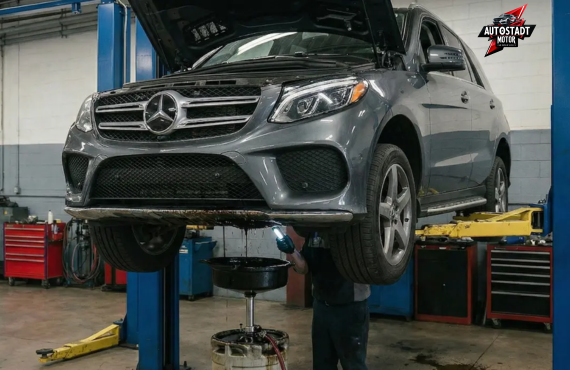
Whether you drive a Mercedes-Benz C-Class for everyday commuting, an E-Class for business travel, a GLE for family journeys, or an S-Class for premium comfort, timely engine inspection can help protect your investment. Understanding the warning signs and available repair options is the first step toward keeping your Mercedes in good condition.
Signs Your Car Needs Mercedes Oil Leak Repair
Engine oil leaks do not always appear as large puddles. In some cases, oil escapes slowly, collects around engine components, or burns on hot surfaces before reaching the ground. Recognizing the symptoms early can help prevent further complications.
1. Oil Spots Beneath Your Mercedes
Fresh oil underneath the front or middle section of your parked vehicle is one of the most recognizable signs of a possible leak. The location of the stain can offer an initial clue, although oil may travel across engine components before dripping onto the ground.
Engine oil is commonly amber or brown when relatively fresh and may become darker with use. However, colour alone cannot confirm the source because other automotive fluids can look similar.
If you notice repeated oil spots in your parking space, arrange an inspection instead of relying on regular top-ups.
2. Burning Oil Smell After Driving
A noticeable burning smell can indicate that leaking engine oil is contacting hot engine or exhaust components. This may happen when oil escapes from a gasket, seal, or nearby connection.
The smell can become more noticeable after a journey or when the vehicle is stationary following a drive. In some cases, light smoke may also appear from the engine bay.
Do not ignore smoke or a strong burning smell. If smoke is substantial or there is a risk of fire, stop safely, switch off the engine, leave the vehicle if necessary, and seek professional assistance.
3. Engine Oil Level Drops Repeatedly
If your Mercedes requires frequent oil top-ups between scheduled services, it is worth investigating the reason.
Oil consumption and external leakage are different problems. An engine may consume oil internally without leaving visible stains, while an external leak can reduce the oil level even if the engine otherwise runs normally.
A technician can inspect the engine for visible leakage and assess whether further testing is needed to determine the cause of oil loss.
4. Oil Around the Valve Cover or Engine Seals
The valve cover gasket helps prevent oil from escaping around the top of the engine. Over time, heat exposure and material ageing can affect the gasket’s ability to maintain a proper seal.
Oil around the valve cover, cylinder head area, or other sealing surfaces may indicate a developing problem. Depending on the engine design, the oil may spread onto surrounding components and make the original leak difficult to identify.
5. Oil Warning Light or Low Oil Pressure
An oil warning light must be treated seriously. It may indicate low oil pressure or another lubrication-related issue, rather than simply reminding you that the engine needs an oil change.
If the red oil pressure warning appears while driving, stop as soon as it is safe and switch off the engine. Continuing to drive with insufficient oil pressure can cause severe engine damage.
Adding oil without identifying the reason for the warning is not always sufficient. The lubrication system may require immediate diagnosis.
6. Oil Residue Around the Oil Filter Housing
The oil filter housing and its seals are possible leak points on certain Mercedes-Benz engines. Oil residue in this area may develop gradually and spread to nearby components.
During an inspection, the technician should distinguish between leakage from the housing, a nearby gasket, a service-related spill, and another source higher up the engine.
Accurate identification matters because replacing the wrong component may leave the original leak unresolved.
Common Causes of Mercedes Oil Leaks in Dubai
Several mechanical issues can cause oil to escape from a Mercedes engine. The precise cause depends on the model, engine generation, maintenance history, and condition of the affected components.
Ageing Gaskets and Seals
Gaskets and seals are designed to contain engine oil under operating conditions. Over time, however, they can harden, shrink, crack, or lose their sealing effectiveness.
Valve cover gaskets, oil pan gaskets, and crankshaft seals are among the components that may require attention as a vehicle ages.
Oil Filter Housing or Drain Plug Problems
A damaged seal, incorrectly fitted filter component, or drain plug issue can lead to oil leakage. Sometimes, leakage becomes noticeable shortly after an oil change.
Correct installation and the use of suitable replacement parts are therefore important during routine maintenance.
Turbocharger Oil Line Leaks
Some Mercedes engines use turbochargers that rely on engine oil for lubrication. Depending on the engine configuration, leaking oil feed or return lines and their seals may contribute to oil loss.
Because these components operate in demanding conditions, the affected area should be inspected carefully before deciding whether a line, seal, or another component needs repair.
Previous Repairs or Incorrect Installation
A leak can sometimes develop after maintenance if a gasket has been incorrectly fitted, a connection has not been secured according to specification, or excess oil has been spilled during servicing.
This is another reason why identifying the source is more effective than immediately replacing parts.
Dubai Driving Conditions
High ambient temperatures, frequent traffic congestion, and repeated short journeys can place additional demands on vehicle maintenance. Nevertheless, hot weather alone does not prove that a particular seal has failed.
The condition of the engine, service history, oil specification, and the exact location of the leak all need to be considered.
Why Choose AutoStadt Motor Services for Mercedes Oil Leak Repair
Choosing the right workshop means finding a service provider that investigates the cause of the problem instead of treating every oil leak as identical.
Accurate Leak Detection
At AutoStadt Motor Services, the diagnostic process begins with a visual assessment of the engine and the areas where oil appears to be escaping.
Depending on the symptoms, inspection may include the valve cover, oil filter housing, oil pan, seals, turbocharger oil lines, and surrounding components. Cleaning the affected area and checking it again may help identify the precise source when oil has spread across several surfaces.
Repair Recommendations Based on the Fault
Not every oil leak requires extensive engine work. A leaking gasket may need replacement, while a loose or damaged connection may require a different solution.
However, a leak involving a difficult-to-access seal or a turbocharger-related component can require more labour. The recommended repair should reflect the actual condition of the vehicle.
Attention to Mercedes-Benz Requirements
Mercedes-Benz engines differ across model years, engine types, and generations. The correct oil specification, component design, sealing method, and repair procedure may therefore vary.
A Mercedes C-Class does not necessarily require the same repair approach as a GLC, GLE, or S-Class. Vehicle-specific diagnosis helps ensure that the repair is appropriate for the engine installed.
Preventing Avoidable Engine Damage
Engine oil lubricates moving parts and helps control friction and heat. When the oil level becomes too low, important components may not receive adequate lubrication.
Addressing a leak early can help reduce the risk of further damage. It can also help prevent repeated oil top-ups from becoming a substitute for proper maintenance.
Professional Support for Different Vehicle Brands
AutoStadt Motor Services also serves as a point of contact for drivers seeking general automotive maintenance and repair. Although a Mercedes-Benz requires model-specific attention, other vehicles, such as the BMW 5 Series, Audi Q7, Toyota Land Cruiser, and Nissan Patrol, also require accurate oil leak diagnosis according to their individual engine designs.
How Our Mercedes Oil Leak Repair Process Works
A systematic repair process helps ensure that the source of the oil loss is identified and that the final repair addresses the original complaint.
Step 1: Discuss the Symptoms
The process begins by understanding what the owner has noticed. This may include oil spots under the vehicle, a burning smell, a low oil level, or oil residue discovered during servicing.
Information about when the leak occurs and whether the vehicle was recently serviced can help guide the initial inspection.
Step 2: Inspect the Engine
The technician examines the engine and accessible components for signs of oil leakage. Particular attention is given to likely leak points based on the vehicle’s engine design and reported symptoms.
If necessary, surrounding areas may be cleaned so that fresh leakage can be distinguished from older residue.
Step 3: Identify the Source
Once the affected area is narrowed down, the technician determines which component is responsible.
The leak could originate from a gasket, seal, housing, drain plug, oil line, or another engine component. Where the source is not immediately clear, further diagnostic checks may be necessary.
Step 4: Explain the Required Repair
After the cause has been identified, the recommended work can be explained to the vehicle owner.
This includes identifying the affected component and determining whether replacement, resealing, or another repair is appropriate. The extent of labour and any additional work should be considered before proceeding.
Step 5: Carry Out the Repair
The necessary repair is then performed using a procedure suitable for the particular Mercedes-Benz engine.
Depending on the fault, this may involve replacing a gasket, renewing a seal, correcting an oil filter housing leak, addressing an oil line, or repairing another confirmed source.
The correct engine oil specification and service requirements must also be followed.
Step 6: Verify the Results
After the repair, the affected area is checked for signs of continued leakage. The oil level is verified, and any relevant warning symptoms are reassessed.
Where appropriate, the vehicle may be checked under operating conditions to confirm that the repair has addressed the original problem.
A final inspection is important because removing visible oil residue alone does not prove that the underlying leak has been repaired.
Frequently Asked Questions About Mercedes Oil Leak Repair in Dubai
1. How much does Mercedes oil leak repair cost in Dubai?
The cost depends on the source of the leak, the Mercedes model, the engine configuration, the parts required, and the labour involved. Replacing an accessible gasket may be relatively straightforward, while repairing a difficult-to-access seal or turbocharger oil line may require more work. AutoStadt Motor Services can inspect the vehicle and recommend a repair based on the confirmed fault before you commit to the work.
2. Is it safe to drive a Mercedes with an engine oil leak?
That depends on the severity of the leak and the vehicle’s condition. A small external leak may not immediately affect engine operation, but it can worsen and reduce the oil level. If the red oil pressure warning appears, the engine makes unusual mechanical noises, or smoke develops, stop safely and switch off the engine. Do not continue driving with a low-oil-pressure warning; arrange professional assistance instead.
3. Why is my Mercedes leaking oil after an oil change?
Oil leakage after servicing may be related to an incorrectly fitted oil filter component, a damaged seal, a drain plug problem, or oil spilled onto engine surfaces during maintenance. Sometimes, old residue becomes visible after the service even though it is not an active leak. A proper inspection can distinguish between these possibilities and identify whether corrective work is required.
4. Can a Mercedes oil leak damage the engine?
Yes. If the leak causes the engine oil level or oil pressure to fall below the required level, important internal components may not receive sufficient lubrication. This can result in severe engine damage. Some leaks may also allow oil to contact hot components, creating smoke or a potential fire hazard. Early diagnosis is therefore preferable to repeatedly topping up the oil and postponing the repair.
5. How long does Mercedes oil leak repair take?
Repair time varies according to the location of the leak and the amount of work required to access the affected component. An accessible connection may be repaired relatively quickly, whereas a seal requiring substantial disassembly can take considerably longer. Parts availability and the need for additional testing may also affect completion time. A workshop inspection is the best way to obtain a realistic estimate for your particular vehicle.
Conclusion
Mercedes oil leak repair is an important part of maintaining engine reliability, particularly when you notice fresh oil beneath your vehicle, a burning smell, a falling oil level, or oil residue around engine components. Although some leaks begin gradually, delaying inspection can increase the risk of further damage and higher repair costs.
The most effective solution is to identify the source before replacing parts. Whether the problem involves a valve cover gasket, oil filter housing, oil pan, crankshaft seal, turbocharger oil line, or another component, the correct repair depends on your Mercedes model and engine configuration.
AutoStadt Motor Services provides professional automotive inspection and repair support for Mercedes-Benz owners in Dubai, with an emphasis on identifying the fault and recommending suitable corrective work.
If your Mercedes is losing oil or showing signs of an engine oil leak, arrange an inspection before the problem becomes more serious. Prompt attention can help protect the engine, support dependable performance, and give you greater confidence on Dubai’s roads.


Leave a Comment