
Mercedes coolant leak repair is essential when your vehicle begins losing coolant, develops an unusual sweet smell, shows a coolant warning, or experiences rising engine temperatures. Mercedes-Benz vehicles are engineered for refined performance and reliable driving, but their cooling systems still depend on properly functioning hoses, seals, radiators, pumps, and other components. When even one part develops a leak, the engine may no longer maintain its correct operating temperature.
For Mercedes owners in Dubai, a cooling system problem deserves particular attention. Heavy traffic, long commutes, frequent stop-and-go driving, and high ambient temperatures can place considerable demands on the engine cooling system. A small coolant leak that initially appears manageable can become more serious if the coolant level continues to drop or the engine overheats.
At AutoStadt Motor Services, the focus of Mercedes coolant leak repair is to identify the source of coolant loss and recommend a suitable repair based on the vehicle’s actual condition. Simply topping up the coolant may temporarily restore the correct level, but it will not resolve a leaking hose, damaged radiator, failing water pump, or defective seal.
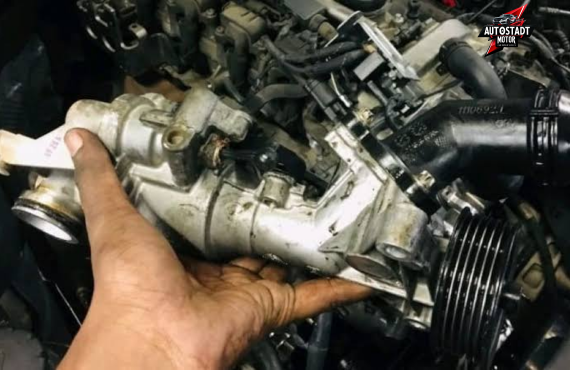
Mercedes models also vary in their engine configurations and cooling system designs. A Mercedes-Benz C-Class may require a different diagnostic approach from an E-Class, GLE, or GLS. Therefore, accurate diagnosis and model-specific repair procedures are important for protecting engine performance and avoiding unnecessary component replacement.
Signs Your Car Needs Mercedes Coolant Leak Repair
Coolant leaks do not always begin with a large puddle underneath the vehicle. Sometimes, the first indication is a warning message or a gradual reduction in coolant level. Recognizing these signs early can help prevent further damage.
1. Coolant Puddles Under Your Mercedes
One of the most noticeable signs is a coloured or watery fluid collecting beneath the engine bay after parking. Depending on the coolant formulation, the fluid may appear pink, blue, green, yellow, or another colour.
However, colour alone cannot confirm the source because different coolant formulations exist, and other vehicle fluids may also leave marks underneath the car. Air-conditioning condensation, for example, can produce clear water without indicating a coolant leak.
If you repeatedly notice fluid under your Mercedes, arrange an inspection to identify where it is coming from instead of assuming it is harmless condensation.
2. Repeated Low Coolant Warnings
Modern Mercedes vehicles may display a dashboard warning when the coolant level falls below the expected range.
If the warning returns shortly after topping up the coolant, there may be a leak or another cooling system problem. The coolant reservoir, hoses, radiator connections, water pump, and other components should be inspected as appropriate for the model.
Repeatedly ignoring a low coolant warning can allow the engine to operate with insufficient coolant, increasing the risk of overheating.
3. Engine Temperature Rises Above Normal
A rising temperature gauge or an engine temperature warning is a serious sign that should never be overlooked.
Coolant absorbs heat from the engine and transfers it through the radiator. When the system loses too much coolant, its ability to regulate engine temperature may be compromised.
If your Mercedes begins overheating, stop somewhere safe and switch off the engine. Do not continue driving in the hope that the temperature will return to normal. Never remove the coolant reservoir cap while the system is hot or pressurised, as escaping steam and coolant can cause severe burns.
4. Sweet Smell Around the Engine Bay
Engine coolant often has a distinctive sweet or chemical smell. If you notice this smell after driving or when standing near the front of your vehicle, a coolant leak may be present.
The source could be an external leak from a hose, radiator, water pump, or connection. In some cases, coolant may escape onto a hot component and evaporate before reaching the ground.
A visible puddle is therefore not necessary for a coolant leak to exist.
5. Steam or Visible Coolant Residue
Steam from the engine compartment can indicate a serious cooling system problem, particularly when accompanied by rising engine temperature.
You may also notice dried residue around hose connections, the radiator, or the coolant reservoir. Such deposits can form when small amounts of coolant escape and evaporate.
If steam appears or the engine overheats, stop driving as soon as it is safe to do so and arrange professional assistance.
6. Unusual Heating or Cooling Behaviour
Changes in cabin heating can sometimes accompany cooling system problems. For example, the heater may produce inconsistent warmth if coolant circulation is affected or the system has an air pocket.
This symptom alone does not prove that coolant is leaking. However, when combined with falling coolant levels or temperature fluctuations, it provides another reason to inspect the cooling system.
Why Choose AutoStadt Motor Services for Mercedes Coolant Leak Repair
A successful repair depends on identifying the actual fault rather than replacing components based on assumptions. AutoStadt Motor Services approaches Mercedes coolant leak repair with attention to diagnosis, suitable replacement parts, and post-repair checks.
Accurate Cooling System Diagnosis
Coolant can travel across surrounding components before dripping onto the ground. Consequently, the point where fluid appears beneath the car may not be the original leak location.
A proper inspection examines the relevant cooling system components and looks for evidence of active leakage. Where appropriate, a pressure test can help identify leaks that are difficult to see during a visual inspection.
This process helps narrow down the source and reduces the risk of replacing a component that is not responsible for the problem.
Inspection of Mercedes-Specific Components
Depending on the engine and model, a Mercedes cooling system may include a radiator, coolant reservoir, thermostat housing, water pump, hoses, seals, auxiliary cooling components, and other connections.
Plastic fittings and seals can deteriorate over time, while hoses may become damaged or weakened. The exact components requiring attention depend on the vehicle’s design, age, maintenance history, and operating condition.
AutoStadt Motor Services can assess the affected areas and recommend repairs based on the specific Mercedes model.
Suitable Coolant and Replacement Parts
Using the correct coolant specification is important because not every coolant formulation is suitable for every Mercedes vehicle.
Mixing incompatible products or using an unsuitable coolant can create problems with corrosion protection and cooling system performance. Replacement components should likewise meet the vehicle’s requirements.
The appropriate specification should be confirmed using the manufacturer’s guidance for the particular model and engine.
Repair Recommendations That Make Sense
Not every coolant leak requires a radiator or water pump replacement. In some cases, a hose, clamp, connection, reservoir, or seal may be responsible.
By identifying the faulty component first, the workshop can recommend a repair that addresses the problem without unnecessary work.
This is particularly valuable for premium vehicles, where replacing major components without confirming the fault can lead to avoidable expense.
Support for Different Vehicle Makes
Although this service focuses on Mercedes-Benz, cooling system diagnosis is important for many vehicles, including BMW, Audi, Toyota, and Nissan models.
Each manufacturer uses different component designs and coolant requirements. Therefore, repairs should be carried out according to the specific vehicle rather than relying on a generic procedure.
How Our Mercedes Coolant Leak Repair Process Works
A structured diagnostic process helps determine why coolant is escaping and whether the system can operate safely after the repair.
Step 1: Discuss the Symptoms
The process begins by understanding what the driver has noticed.
Important details include how often the coolant level drops, whether the dashboard displays a warning, when the leak occurs, and whether the engine has overheated.
Information about previous repairs or recent coolant top-ups can also help identify possible causes.
Step 2: Inspect the Cooling System
The technician examines accessible cooling system components for visible wetness, dried coolant residue, damaged hoses, loose connections, and other signs of leakage.
Depending on the vehicle and symptoms, the inspection may cover the radiator, coolant reservoir, water pump area, thermostat housing, hoses, and associated fittings.
The goal is to establish where further testing is needed.
Step 3: Test for Hidden Leaks
Some leaks only become apparent when the cooling system reaches a particular operating condition or pressure.
Where suitable, a cooling system pressure test can help reveal leakage that is not obvious during a basic visual inspection. Additional diagnostic methods may be required if an external leak cannot be located.
If internal coolant loss is suspected, further testing may be necessary to investigate possible engine-related faults.
Step 4: Confirm the Fault and Recommend a Repair
Once the source has been identified, the technician can determine the appropriate repair.
For example, a damaged hose may require replacement, while a leaking radiator or water pump may need more extensive work. A defective reservoir or thermostat housing can require a different solution.
The repair recommendation should be based on the evidence gathered during diagnosis.
Step 5: Complete the Necessary Repair
The affected component is repaired or replaced as required. The correct coolant specification must be used, and the cooling system should be filled and bled according to the manufacturer’s procedure where applicable.
Proper bleeding is important because trapped air can interfere with coolant circulation and temperature regulation.
Step 6: Verify Cooling System Performance
After the repair, the system should be checked for continued leakage and correct coolant level. Relevant temperature readings and cooling system operation can also be assessed.
A final inspection helps confirm that the original problem has been addressed and that no obvious signs of leakage remain.
Preventing Mercedes Coolant Leaks in Dubai
Preventive maintenance can help identify cooling system problems before they develop into more serious faults.
First, pay attention to the coolant level and follow the manufacturer’s inspection recommendations. If the level repeatedly drops, investigate the cause rather than making frequent top-ups a normal routine.
Second, arrange an inspection when you notice residue around hoses, a coolant smell, or unexplained fluid beneath the vehicle. Small leaks may be easier to repair before they affect other components.
Third, take temperature warnings seriously. If the engine overheats, continued driving can cause significant damage to engine components and may turn a relatively straightforward repair into a major expense.
Finally, keep maintenance records and use the coolant specification approved for your Mercedes model. Regular servicing does not guarantee that a leak will never develop, but it can help identify deterioration and other developing problems.
For drivers who regularly travel through Dubai traffic, these precautions are especially useful because cooling system problems can become more noticeable during demanding driving conditions.
Frequently Asked Questions About Mercedes Coolant Leak Repair in Dubai
1. How much does Mercedes coolant leak repair cost in Dubai?
The cost depends on the location of the leak, the affected component, the Mercedes model, and the labour required. Replacing a damaged hose or connection is generally a different job from replacing a radiator, water pump, or other major component. Additional diagnostic work may also be needed if the leak is difficult to locate. AutoStadt Motor Services can assess the vehicle and recommend the appropriate repair after identifying the source of coolant loss.
2. Can I drive my Mercedes if the coolant is leaking?
Driving with a coolant leak is risky because the leak may worsen and cause the engine to overheat. If the coolant warning appears, the temperature rises, or steam comes from the engine bay, stop somewhere safe and switch off the engine. Do not open the coolant reservoir while the engine is hot. If the vehicle is overheating or losing coolant rapidly, arrange recovery rather than continuing to drive.
3. Why does my Mercedes keep losing coolant without a visible leak?
Coolant may escape from a component where the leak is difficult to see, evaporate on a hot surface, or collect in an area that is not easily visible. In other situations, internal coolant loss may be involved. A pressure test and further diagnostic checks can help identify the cause. Repeatedly topping up the reservoir without investigating the problem will not resolve the underlying fault.
4. Can a Mercedes coolant leak damage the engine?
Yes. If enough coolant is lost, the engine may overheat. Excessive temperatures can damage gaskets, cylinder head components, and other engine parts, potentially resulting in expensive repairs. The level of risk depends on the severity of the leak and how long the engine operates under those conditions. Early diagnosis is therefore important, particularly if the vehicle displays a temperature warning or loses coolant quickly.
5. Which components commonly cause coolant leaks in Mercedes vehicles?
Potential sources include radiator connections, coolant hoses, reservoirs, water pumps, thermostat housings, seals, and other cooling system fittings. The likely cause depends on the Mercedes model, engine design, mileage, and maintenance history. A pressure test and visual inspection can help narrow down the source. Not every vehicle will experience the same failure, so replacing parts without diagnosis is not recommended.
Conclusion
Mercedes coolant leak repair is an important service for protecting engine temperature control and maintaining dependable vehicle performance in Dubai. Whether you notice a coolant warning, fluid beneath the car, a sweet smell, or unexplained coolant loss, the problem should be investigated before it leads to overheating.
The most effective approach is to locate the source of the leak, assess the affected component, use the correct coolant specification, and verify the system after the repair. Simply topping up the reservoir may provide temporary relief, but it does not fix a damaged hose, leaking radiator, failing water pump, or defective seal.
AutoStadt Motor Services provides cooling system inspection and repair support for Mercedes owners in Dubai. By focusing on accurate diagnosis and suitable repairs, the workshop can help drivers address coolant leaks before they develop into more serious problems.
If your Mercedes is losing coolant or showing signs of a cooling system fault, arrange an inspection promptly. Taking action early can help protect the engine, avoid unnecessary repair costs, and support more reliable driving in Dubai’s demanding conditions.


Leave a Comment