
Mercedes oil change is an essential part of maintaining engine performance, fuel efficiency, and long-term reliability. Whether you drive a Mercedes-Benz C-Class for daily commuting, an E-Class for business travel, or a GLE SUV for family journeys, regular engine oil maintenance helps protect the engine from friction, heat, and premature wear.
Dubai’s driving conditions make timely oil changes particularly important. High ambient temperatures, frequent traffic congestion, repeated short trips, and extended periods of idling can place additional demands on engine oil. Over time, oil collects contaminants and gradually loses some of its ability to protect moving engine components. Using the correct oil and replacing it at the appropriate interval helps maintain smooth operation.
However, a Mercedes oil change involves more than draining old oil and adding a fresh supply. Mercedes-Benz engines have specific lubrication requirements, and the correct oil grade, manufacturer approval, oil capacity, and service interval depend on the engine and model year. Choosing an unsuitable oil may affect lubrication performance and could create problems over time.
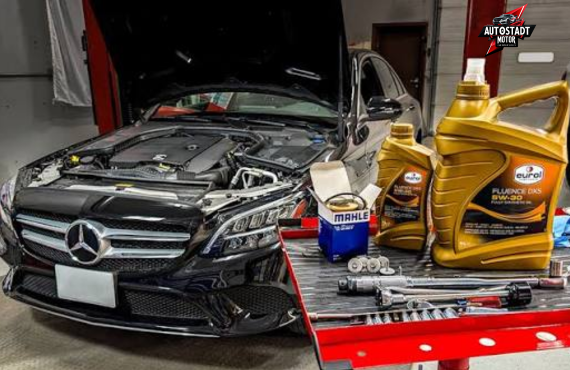
At AutoStadt Motor Services, Mercedes owners can receive professional engine oil replacement and related maintenance checks. The aim is to help drivers maintain their vehicles according to their specific requirements rather than relying on a one-size-fits-all servicing approach.
Signs Your Car Needs a Mercedes Oil Change
Engine oil does not always provide an obvious warning when it begins to deteriorate. Nevertheless, several indicators can help you determine when your Mercedes may need an oil service.
1. The Service Reminder Appears on the Dashboard
Many Mercedes-Benz vehicles use a service-assistance system to notify drivers when scheduled maintenance is approaching. Depending on the model, the dashboard may display a service reminder or maintenance message.
This notification should not be ignored. Instead, check the vehicle’s service history and maintenance requirements to determine which service is due.
If you have recently purchased a used Mercedes and cannot verify when the previous oil change was completed, arranging an inspection is a sensible first step.
2. Engine Oil Looks Dirty or Contaminated
Fresh engine oil generally has a cleaner appearance than oil that has been circulating through an engine for an extended period. As the engine operates, the oil collects microscopic contaminants and combustion-related deposits.
However, colour alone is not a reliable way to determine whether oil needs replacement. Some oils darken relatively quickly during normal operation, while other problems may develop without an obvious visual change.
A better approach is to consider the manufacturer’s recommended service interval, dashboard reminders, service records, and any unusual engine symptoms.
3. Unusual Engine Noise Develops
Engine oil forms a protective film between moving metal surfaces. If the oil level is too low or its lubrication properties have deteriorated, some components may not receive adequate protection.
You might notice unusual ticking, rattling, or other mechanical sounds. These noises do not automatically mean the oil is overdue for replacement, since they can also indicate a separate mechanical fault.
If an oil-pressure warning appears or the engine develops a sudden, pronounced noise, stop safely and follow the vehicle’s instructions. Continuing to drive with inadequate oil pressure can cause severe engine damage.
4. The Oil Level Is Below the Recommended Range
A low oil level is an important reason to inspect your Mercedes.
Oil can decrease because of leakage, consumption, or another engine-related problem. Regularly adding oil without identifying why the level is dropping may leave an underlying issue unresolved.
At AutoStadt Motor Services, an oil service can include checking the level and inspecting accessible areas for signs of leakage, depending on the service required.
5. Your Mercedes Has Covered the Recommended Service Distance
Even if the engine sounds normal, maintenance should not be delayed simply because there are no obvious symptoms.
Mercedes-Benz service intervals vary by model, engine, driving conditions, and applicable maintenance schedule. Vehicles used extensively in traffic or under demanding conditions may require particular attention to their servicing requirements.
Keeping accurate records makes it easier to track when the next engine oil and filter replacement is due.
6. You Notice an Oil Leak
Dark, oily spots beneath your vehicle may indicate an engine oil leak, although other automotive fluids can sometimes be mistaken for engine oil.
Possible sources include seals, gaskets, the oil filter housing, the drain plug, or other engine components. Replacing the oil alone will not resolve a leak.
If you notice fresh oil beneath your Mercedes, arrange an inspection to identify the source and determine whether a repair is necessary.
Why Choose AutoStadt Motor Services for Mercedes Oil Change
A suitable oil service should protect the engine while taking the vehicle’s technical requirements into account. At AutoStadt Motor Services, the focus is on appropriate maintenance, careful checks, and clear repair recommendations.
Correct Engine Oil for Your Mercedes-Benz
Not every Mercedes engine uses the same oil specification. Requirements can differ between petrol and diesel engines, older vehicles, modern turbocharged engines, and models equipped with particular emissions-control systems.
The correct selection should be based on the owner’s manual or the manufacturer’s applicable oil approval for the exact vehicle. Viscosity alone, such as 5W-30 or 0W-40, is not enough to establish suitability.
Using an oil that meets the required specification helps ensure that lubrication performance matches the engine’s design.
Professional Oil and Filter Replacement
The oil filter plays an important role in capturing contaminants circulating through the lubrication system. Therefore, replacing engine oil without addressing the filter when it is due can undermine the value of the service.
A professional oil change includes draining the old oil, replacing the filter as required, and filling the engine with the correct oil in the specified quantity.
The oil level should then be checked according to the vehicle’s prescribed procedure.
Maintenance Suited to Dubai Driving
Dubai drivers may encounter heavy traffic, high outdoor temperatures, extended idling, and repeated journeys over short distances. These conditions can influence how a vehicle is used and maintained.
Although the correct service interval must come from the manufacturer’s guidance, discussing your driving pattern helps the workshop understand the demands placed on your Mercedes.
This is particularly useful for owners who use their cars daily for commuting, business appointments, or frequent journeys across the city.
Inspection Beyond the Oil Itself
An oil service can also provide an opportunity to identify other visible maintenance concerns.
Depending on the service package and vehicle, checks may include fluid levels, visible leaks, the condition of accessible engine components, and other routine maintenance items.
For example, a Mercedes oil change appointment may reveal an issue that deserves further inspection before it becomes more expensive to address.
Support for Different Mercedes Models
Different Mercedes-Benz vehicles have different servicing requirements. A compact A-Class, a C-Class sedan, an E-Class, a GLC SUV, and a performance-oriented AMG model should not automatically receive identical oil specifications or service procedures.
AutoStadt Motor Services can assess the vehicle’s requirements and recommend the appropriate oil service for the model and engine.
The same principle applies when comparing Mercedes-Benz with BMW, Audi, Toyota, or Nissan: each vehicle must be maintained according to its own specifications.
How Our Mercedes Oil Change Process Works
A structured service process helps ensure that the right oil is used and the maintenance is completed correctly.
Step 1: Identify the Vehicle and Its Requirements
The process begins by confirming the Mercedes model, model year, engine type, and available service history.
These details help establish the appropriate oil specification, approximate capacity, filter requirements, and maintenance procedure. Where necessary, the vehicle identification information can help clarify the exact engine configuration.
This first step reduces the risk of choosing an oil based on assumptions.
Step 2: Review the Oil Level and Existing Condition
The current oil level is checked using the method specified for the vehicle. Depending on the model, this may involve an electronic measurement system or a manual procedure where provided.
The technician can also look for signs of leakage and discuss any concerns reported by the owner, such as oil consumption, dashboard warnings, or unusual engine noise.
If symptoms suggest a more serious fault, further diagnosis may be needed before proceeding.
Step 3: Drain the Used Engine Oil
The old engine oil is drained using the appropriate workshop procedure.
Allowing the used oil to drain properly helps remove the existing lubricant before fresh oil is introduced. The drain plug and related components are also checked as appropriate for signs of damage or leakage.
Used oil must be collected and handled responsibly rather than disposed of improperly.
Step 4: Replace the Oil Filter
The oil filter is replaced according to the vehicle’s maintenance requirements. The correct filter and any required sealing components should be used to ensure a suitable fit.
Careful installation matters because an incorrectly fitted filter or damaged seal can cause leakage after the service.
Step 5: Add the Approved Engine Oil
Fresh engine oil is added in the correct specification and quantity for the particular Mercedes engine.
The quantity should not be estimated using another model’s requirements. Overfilling and underfilling can both create problems, so the final level must be verified using the appropriate procedure.
Step 6: Check for Leaks and Confirm the Oil Level
After the oil and filter replacement, the relevant areas are checked for signs of leakage.
The engine oil level is verified as required, and any applicable maintenance reminder or service indicator is addressed according to the manufacturer’s procedure.
The technician should also ensure that the service has not introduced any new issues.
Step 7: Review the Service and Next Maintenance Due
Finally, the completed work can be explained to the vehicle owner. Keeping a record of the oil specification, service date, and mileage helps with future maintenance planning.
If other concerns were identified during the inspection, they can be discussed separately so you can decide which work requires attention.
Mercedes Oil Change: Maintenance Tips for Dubai Drivers
Regular oil maintenance is easier when it becomes part of a consistent vehicle-care routine.
First, follow the service interval specified for your particular Mercedes rather than relying on a universal mileage figure. The appropriate interval may depend on the engine, maintenance system, and driving conditions.
Second, do not assume that all premium synthetic oils are interchangeable. Two products can share the same viscosity grade but have different manufacturer approvals. Always check that the selected oil meets the exact requirement for your vehicle.
Third, pay attention to oil-level warnings and unexplained drops in the level. If your Mercedes repeatedly requires additional oil between services, arrange an inspection to determine whether there is a leak or excessive consumption.
Finally, retain service invoices and maintenance records. These records help you track upcoming maintenance and can be useful when selling the vehicle.
For drivers who also own a Tesla, Toyota, or Nissan, remember that maintenance schedules and powertrain requirements differ significantly. A petrol or diesel Mercedes needs engine oil, while a fully electric vehicle does not require a conventional engine oil change.
Frequently Asked Questions About Mercedes Oil Change in Dubai
1. How often should I get a Mercedes oil change in Dubai?
The correct interval depends on your Mercedes model, engine, model year, maintenance system, and driving conditions. Many vehicles use service schedules that account for mileage and time, but one interval should not be assumed to apply to every Mercedes. Dubai’s traffic and repeated short trips may also influence maintenance needs. Check your owner’s manual or service indicator and consult a qualified workshop if the service history is unclear.
2. Which engine oil is best for a Mercedes-Benz?
The best engine oil is one that meets the manufacturer’s required specification and approval for your exact engine. Viscosity grades such as 0W-30, 5W-30, or 5W-40 do not independently determine whether an oil is suitable. The correct choice can vary by model and engine generation. Before an oil change, confirm the required approval using the owner’s manual or reliable vehicle-specific service information.
3. How much does a Mercedes oil change cost in Dubai?
The cost depends on the model, engine oil capacity, required oil specification, filter, and any additional maintenance included in the service. Some vehicles require more oil or specialised filters than others. If inspection reveals a leak or another problem, that repair may be priced separately. AutoStadt Motor Services can assess the vehicle’s requirements and provide a recommendation based on the service needed.
4. Should I change the oil filter every time I change the engine oil?
For routine Mercedes engine oil service, the oil filter is generally replaced alongside the engine oil according to the applicable maintenance schedule. The filter captures contaminants and helps maintain proper oil cleanliness. Using the correct filter and installing it properly are also important. Always follow the maintenance procedure specified for your particular engine rather than applying a rule from another vehicle.
5. Can I drive my Mercedes if the engine oil warning appears?
The meaning of the warning matters. A low oil-level message requires prompt attention and a level check according to the vehicle’s instructions. An engine oil-pressure warning is more serious: stop safely, switch off the engine, and follow the owner’s manual guidance. Do not continue driving with a red oil-pressure warning, as insufficient oil pressure can cause severe engine damage. If the cause is uncertain, arrange professional assistance before restarting or driving the vehicle.
Conclusion
Mercedes oil change is a fundamental maintenance service that helps protect engine components, support reliable performance, and maintain the vehicle according to its engineering requirements. In Dubai, where traffic congestion and high temperatures can make everyday driving demanding, staying on top of scheduled maintenance is especially worthwhile.
The right approach involves more than choosing a popular synthetic oil. It requires the correct manufacturer approval, a suitable oil filter, accurate filling, and checks for leaks or other developing concerns.
AutoStadt Motor Services helps Mercedes owners maintain their vehicles through professional engine oil and filter replacement, vehicle-specific servicing, and relevant maintenance checks.
Whether you drive a Mercedes-Benz C-Class, E-Class, GLC, or another model, arrange your next oil service according to the vehicle’s requirements. Keeping accurate maintenance records and responding promptly to oil warnings can help protect your investment and support dependable driving for years to come.


Leave a Comment