
Opel evaporator change is an important air conditioning repair when the evaporator inside your vehicle develops a refrigerant leak, becomes contaminated, or can no longer transfer heat efficiently. Because the evaporator is located deep inside the vehicle’s HVAC system, replacing it is considerably more involved than changing an easily accessible AC component such as a fuse, relay, or condenser.
For Opel owners in Dubai, a properly functioning AC system is more than a comfort feature. It is essential for maintaining a pleasant cabin environment during daily commuting, traffic congestion, and long-distance driving. If the air conditioner gradually becomes warmer, loses refrigerant repeatedly, or produces unusual smells from the vents, the evaporator may need detailed inspection.
At AutoStadt Motor Services, Opel AC problems are approached through proper diagnosis rather than simply replacing parts. Our technicians inspect the refrigerant circuit, evaporator, expansion valve, cabin airflow, AC pressures, and related components before recommending an Opel evaporator change.
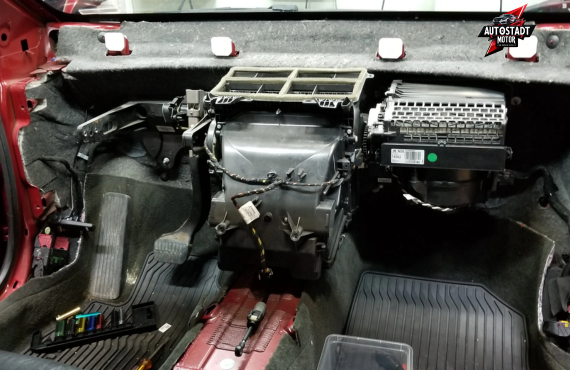
The exact procedure can vary according to the Opel model, HVAC configuration, and the condition of surrounding components. Therefore, identifying the actual source of the problem is the first step toward a reliable repair.
Signs Your Car Needs Opel Evaporator Change
An evaporator problem does not always appear as an obvious mechanical failure. In many cases, the symptoms develop gradually. Recognizing them early can help prevent unnecessary strain on the compressor and reduce the risk of repeated AC repairs.
1. Weak or Warm Air From the AC
One of the most noticeable symptoms is air conditioning that no longer produces sufficiently cold air. You may initially notice that the AC takes longer to cool the cabin. Later, even with the temperature setting at its lowest, the vents may deliver only mildly cool or warm air.
This can happen for several reasons, including low refrigerant, compressor problems, condenser restrictions, or evaporator leakage. Consequently, warm air alone does not automatically mean the evaporator needs replacement. Professional testing is necessary to identify the actual cause.
2. Repeated Refrigerant Loss
If your Opel requires refrigerant recharging repeatedly, there is likely an underlying leak somewhere in the AC system.
An evaporator leak can be particularly difficult to detect because the component is hidden inside the HVAC housing. Adding refrigerant may temporarily restore cooling, but it does not repair the leak. If testing confirms that the evaporator is leaking, an Opel evaporator change becomes the appropriate long-term solution.
3. Unusual Smell From the Vents
A musty, damp, or unpleasant odor coming from the air vents can indicate contamination around the evaporator and HVAC housing. Dust, moisture, bacteria, and organic debris can accumulate in the area over time.
However, an odor does not always mean the evaporator itself has failed. The cabin filter, drain system, and HVAC housing should also be inspected before replacement is recommended.
4. Water Inside the Cabin
The AC system naturally produces condensation as the evaporator removes moisture from cabin air. Normally, this water leaves the vehicle through a dedicated drain.
If the drain becomes blocked, water can accumulate around the HVAC assembly and potentially enter the cabin. Wet carpets or moisture around the passenger footwell should therefore be investigated promptly.
5. AC Compressor Running Frequently
When refrigerant levels are incorrect because of an evaporator leak, the AC system may behave abnormally. Depending on the vehicle’s control system, the compressor may cycle differently or the system may fail to maintain the required pressure.
Continuing to operate an AC system with a refrigerant leak can eventually create additional problems, particularly if the compressor is affected by prolonged low-refrigerant operation.
6. Visible Evidence During AC Diagnosis
Unlike a condenser or external AC pipe, the evaporator is usually hidden behind the dashboard or inside the HVAC casing. Therefore, technicians may rely on pressure testing, electronic leak detection, UV dye where appropriate, or other diagnostic procedures to establish whether the evaporator is leaking.
This is why simply looking underneath the bonnet is not always enough to diagnose an evaporator problem.
Why Choose AutoStadt Motor Services for Opel Evaporator Change
Replacing an evaporator is a labor-intensive repair. Choosing a workshop with experience in automotive AC systems can make a significant difference in the quality and reliability of the final repair.
Accurate AC System Diagnosis
At AutoStadt Motor Services, the objective is to determine whether the evaporator is genuinely responsible for the AC problem before removing interior components.
The technicians can assess refrigerant pressure, cooling performance, leaks, compressor operation, condenser condition, expansion valve operation, and other related components. This helps avoid replacing an expensive part when another component is actually responsible for the problem.
Experienced Opel AC Technicians
Opel vehicles use different HVAC configurations depending on model, engine, and production year. A repair approach that works for one vehicle may not be appropriate for another.
Our technicians take the vehicle’s configuration into account before beginning an evaporator replacement, helping ensure that the correct component and repair procedure are used.
Complete Evaporator Replacement Service
An Opel evaporator change is not simply about removing the old evaporator and installing another one. The surrounding AC system needs to be handled carefully.
Depending on the vehicle, the process may involve dashboard or HVAC component removal, refrigerant recovery, evaporator replacement, O-ring replacement, system evacuation, leak testing, and refrigerant recharging.
AutoStadt Motor Services can manage these related steps as part of a complete AC repair process.
Suitable for Dubai Driving Conditions
Heavy traffic, frequent short journeys, and extended AC usage place considerable demands on a vehicle’s climate control system. A cooling system that appears acceptable during a short test drive may behave differently after prolonged operation.
For this reason, proper post-repair testing is important. The goal is not simply to produce cold air temporarily, but to confirm that the AC system is functioning correctly under normal operating conditions.
Service for Different European and Premium Vehicles
Although this article focuses on Opel, the workshop environment can also support AC-related diagnosis and repair for other European and premium vehicles. Owners of models such as the BMW 3 Series, Mercedes-Benz C-Class, Audi A4, or Nissan Patrol can also require specialized climate-control inspection as their vehicles age.
The exact parts and procedures differ between manufacturers, but the fundamental principle remains the same: diagnose the fault before replacing components.
How Our Opel Evaporator Change Process Works
A proper evaporator replacement should follow a structured process. At AutoStadt Motor Services, the repair can be approached through several important stages.
Step 1: Initial AC Inspection
The technician begins by discussing the symptoms with the vehicle owner. Information such as when the AC becomes warm, whether refrigerant has been added recently, and whether unusual smells or water leaks are present can provide useful diagnostic clues.
The AC system is then inspected to establish its current condition.
Step 2: Refrigerant and Pressure Testing
The refrigerant circuit is checked to determine whether the system contains the correct pressure and whether there is evidence of refrigerant loss.
If the system is low on refrigerant, the next objective is finding out why. Simply topping it up without locating the leak is not considered a proper repair.
Step 3: Leak Detection
If testing indicates a refrigerant leak, the technician investigates the likely source.
External components such as AC hoses, condenser connections, service ports, compressor seals, and expansion valve connections can be inspected first. If these areas are satisfactory and testing points toward the evaporator, further inspection may be required.
Step 4: HVAC and Dashboard Access
Once an evaporator replacement is confirmed, access to the HVAC assembly is required. Depending on the Opel model, this can involve removing selected dashboard panels or other interior components.
This stage requires care because modern vehicles contain wiring harnesses, electronic modules, trim pieces, sensors, and airbag-related components.
Step 5: Evaporator Removal and Replacement
The faulty evaporator is removed from its housing and replaced with the appropriate replacement component.
Technicians also inspect associated seals, connections, expansion valve components, and the evaporator housing. Damaged sealing rings or related fittings may need replacement to prevent future refrigerant leaks.
Step 6: Vacuum and Leak Testing
After the system is reassembled, the AC circuit is evacuated using appropriate service equipment.
A vacuum test helps determine whether the system can maintain the required vacuum and assists in identifying potential leaks or moisture-related issues before refrigerant is introduced.
Step 7: Refrigerant Recharge
Once the system passes the necessary checks, the correct refrigerant charge is restored according to the vehicle’s specifications.
Using the appropriate refrigerant quantity is important. Both undercharging and overcharging can negatively affect AC performance and system pressures.
Step 8: Cooling Performance Check
Finally, the AC system is operated and tested. Vent temperature, airflow, compressor operation, pressure behavior, and overall cabin cooling performance are evaluated.
The vehicle should be checked for abnormal noises, leaks, unusual odors, or other signs that could indicate an unresolved issue.
Frequently Asked Questions About Opel Evaporator Change in Dubai
1. How do I know if my Opel evaporator is leaking?
An evaporator leak may be suspected when the AC repeatedly loses refrigerant without an obvious external leak. Other symptoms can include poor cooling, unusual HVAC odors, or a gradual decline in AC performance.
However, these symptoms can also be caused by other components. A proper leak-detection procedure is therefore necessary before confirming that an evaporator replacement is required.
2. How long does an Opel evaporator change take?
The repair time depends heavily on the Opel model and how difficult it is to access the HVAC assembly. Some vehicles provide relatively straightforward access, while others require substantial dashboard or interior disassembly.
Because of this variation, it is better to receive a vehicle-specific time estimate after inspection rather than relying on a fixed number of hours.
3. Can I repair an Opel evaporator instead of replacing it?
In most cases, replacement is the preferred solution when the evaporator itself has developed a significant refrigerant leak or structural failure.
Because the component is located inside the HVAC assembly and labor can be substantial, installing a reliable replacement is generally more practical than attempting a temporary repair. The technician should nevertheless confirm the fault before recommending replacement.
4. Why does my Opel AC stop cooling after refrigerant recharge?
If the AC works after refrigerant is added but becomes warm again later, a refrigerant leak is a strong possibility. The leak could originate from the evaporator, condenser, hoses, fittings, compressor seals, or another part of the refrigerant circuit.
Repeatedly recharging the system without fixing the leak only provides temporary cooling. AutoStadt Motor Services can inspect the complete AC circuit to identify the source of refrigerant loss.
5. Is an Opel evaporator change expensive in Dubai?
The cost depends on the Opel model, replacement evaporator, labor required to access the HVAC unit, and whether additional components such as seals, expansion valves, or refrigerant lines require attention.
Evaporator replacement can involve considerably more labor than external AC repairs because of its location. For that reason, an accurate quote should be provided after inspection rather than using a generic price.
Conclusion
A reliable Opel evaporator change can restore proper air conditioning performance when an internal evaporator leak or serious component failure is responsible for refrigerant loss and poor cooling. Because the evaporator is located within the vehicle’s HVAC system, accurate diagnosis and careful installation are essential.
For Opel owners in Dubai, ignoring repeated refrigerant loss or continuing to recharge an AC system without repairing the underlying leak can lead to recurring costs and potentially place additional stress on other AC components.
AutoStadt Motor Services provides a diagnostic-first approach to Opel AC repairs, including evaporator inspection, leak detection, component replacement, vacuum testing, refrigerant service, and final cooling-performance checks. Whether your Opel has gradually lost cooling performance or suddenly stopped producing cold air, professional diagnosis can help identify the actual problem and determine the most suitable repair.
For dependable Opel AC service in Dubai, having the evaporator and complete air conditioning system inspected by experienced technicians is a practical way to restore comfortable cabin cooling and maintain reliable performance.


Leave a Comment