
Mitsubishi car repair Dubai services are essential for owners who want dependable performance, safe handling, efficient fuel consumption, and long-term reliability from their vehicles. Mitsubishi models are widely used for daily commuting, family transportation, and longer journeys, but even a reliable vehicle requires proper maintenance as mileage increases.
Dubai driving conditions can be demanding. Heavy traffic, frequent stop-and-go driving, high ambient temperatures, dusty roads, and long periods of air-conditioner use can gradually affect important components. Engine oil, cooling systems, brakes, suspension components, batteries, transmission systems, and air-conditioning parts all require attention at the appropriate service intervals.
At AutoStadt Motor Services, we approach Mitsubishi servicing as more than simply replacing worn parts. Our technicians inspect the vehicle to understand the actual cause of a problem before recommending repairs. Whether you drive a Mitsubishi Pajero, Outlander, ASX, Lancer, or another model, proper diagnosis helps prevent unnecessary repairs and allows small issues to be addressed before they become more expensive.
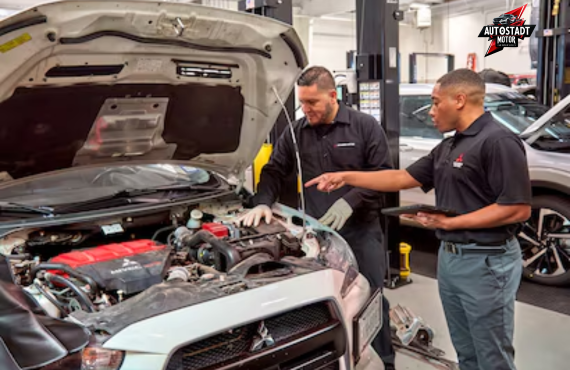
A professional Mitsubishi workshop can also help maintain the vehicle according to its age, mileage, driving pattern, and service history. This is particularly useful for owners who want to keep their Mitsubishi reliable for years rather than waiting until a warning light or major mechanical problem appears.
Signs Your Car Needs Mitsubishi Car Repair Dubai
Recognizing early warning signs can make a significant difference to repair costs and vehicle reliability. A problem that appears minor during the first few days can sometimes develop into a larger mechanical issue if it is ignored.
Unusual Engine Noises or Vibrations
A change in engine sound should not be dismissed as normal aging. Ticking, knocking, rattling, or excessive vibration can be associated with several issues, including worn engine components, belts, mounts, pulleys, or inadequate lubrication.
For example, if your Mitsubishi begins vibrating more than usual while idling, accelerating, or switching on the air conditioner, a technician should inspect the vehicle rather than simply replacing a component based on the symptom.
Warning Lights on the Dashboard
The check-engine light, ABS warning, transmission warning, battery indicator, or other dashboard alerts can indicate an underlying problem. Modern Mitsubishi vehicles use electronic control systems that can store diagnostic trouble codes when a fault is detected.
Professional computer diagnostics can help identify where the problem originates. However, reading a code alone does not always mean that the affected component needs immediate replacement. Further testing is often necessary.
Transmission Problems
Delayed gear engagement, harsh shifting, slipping, unusual transmission noises, or hesitation during acceleration can indicate that the transmission requires inspection.
Automatic transmission fluid condition, leaks, electronic controls, sensors, and mechanical components may all contribute to shifting problems. Addressing these symptoms early can help reduce the possibility of more extensive transmission repairs.
Overheating or Coolant Loss
The cooling system plays an important role in protecting the engine, particularly when a vehicle operates in demanding conditions. If the temperature gauge rises unexpectedly, coolant levels continue dropping, or there is a noticeable coolant smell, the vehicle should be inspected.
Potential causes may include a radiator problem, damaged hose, thermostat issue, water pump fault, cooling fan problem, or coolant leak. Continuing to drive an overheating vehicle can cause serious engine damage.
Steering or Suspension Changes
If your Mitsubishi pulls to one side, produces knocking sounds over uneven roads, feels unstable, or develops excessive body movement, the suspension and steering systems should be checked.
Worn shock absorbers, bushes, ball joints, tie rods, wheel alignment problems, or other suspension components can affect both comfort and handling. Similar symptoms can occur in vehicles such as a Toyota Fortuner or Nissan X-Trail, which is why proper inspection is more useful than assuming the cause.
Weak Air Conditioning
Air conditioning is not a luxury in Dubai; it is an important part of everyday driving. If your Mitsubishi AC takes longer to cool the cabin, produces warm air at idle, makes unusual noises, or has inconsistent cooling, an inspection can identify the underlying issue.
The problem could involve refrigerant level, compressor performance, condenser airflow, electrical components, or another part of the climate-control system.
Brake Noise or Reduced Braking Performance
Squealing, grinding, vibration while braking, a soft brake pedal, or increased stopping distance should be treated seriously. Brake pads, discs, calipers, brake fluid, and related components should be inspected when these symptoms appear.
Routine brake inspections are especially useful before long-distance travel or when a vehicle is frequently driven through congested areas.
Why Choose AutoStadt Motor Services for Mitsubishi Car Repair Dubai
Choosing the right workshop can make the repair process more straightforward and transparent. AutoStadt Motor Services focuses on diagnosis, appropriate repairs, and preventive maintenance rather than treating every vehicle problem as a simple parts-replacement job.
Diagnostic Inspection Before Major Repairs
A proper inspection helps determine what is actually happening with the vehicle. Technicians can assess mechanical components, electronic systems, fluid levels, visible leaks, braking components, suspension parts, and other relevant areas depending on the customer’s complaint.
This approach is useful because the same symptom can have multiple possible causes. For example, poor acceleration might relate to an ignition issue, air intake problem, fuel system, sensor fault, transmission behavior, or another mechanical concern.
Mitsubishi-Focused Maintenance
Different Mitsubishi models have different configurations, specifications, and service requirements. A Pajero used for regular family driving may need a different maintenance approach from an Outlander used primarily for urban commuting.
AutoStadt Motor Services can evaluate the vehicle according to its model, age, mileage, condition, and maintenance history before suggesting the next step.
Genuine-Quality Replacement Parts
When a component has failed, using a suitable replacement is important for reliability. The correct part should match the vehicle’s specifications rather than simply being selected because it appears compatible.
The same principle applies across the automotive market. Whether maintaining a Mitsubishi, BMW, Mercedes-Benz, or Audi, component quality and correct installation can influence the performance and lifespan of the repair.
Preventive Maintenance Instead of Emergency Repairs
Regular servicing can identify developing problems before they cause a breakdown. Oil and filter replacement, brake inspection, battery testing, cooling-system checks, tire inspection, fluid checks, and general vehicle diagnostics can all form part of a sensible maintenance routine.
This is particularly useful for owners who depend on their Mitsubishi every day and cannot afford unexpected downtime.
Customer-Focused Service
A good repair experience should include clear communication about the problem, the recommended repair, and the reason the work is necessary. AutoStadt Motor Services aims to provide customers with understandable information so they can make informed decisions about their vehicles.
How Our Mitsubishi Car Repair Dubai Process Works
A structured repair process makes it easier to identify faults and avoid unnecessary work.
1. Vehicle Check-In and Customer Consultation
The process starts by understanding what the driver has noticed. Information such as unusual sounds, dashboard warnings, recent repairs, fuel-consumption changes, starting problems, overheating, or AC performance can provide useful diagnostic clues.
The technician may also ask when the problem occurs—for example, during cold starts, acceleration, braking, idling, or highway driving.
2. Initial Vehicle Inspection
The vehicle is then inspected based on the reported symptoms. Depending on the problem, this may include checking fluids, belts, hoses, battery condition, brakes, suspension, visible leaks, tires, engine components, and other relevant areas.
This initial assessment helps narrow down the possible causes.
3. Computer Diagnostics Where Required
Modern Mitsubishi vehicles contain numerous electronic control modules. When a warning light or electronic fault is involved, diagnostic equipment can be used to retrieve relevant fault information.
The diagnostic result is then considered alongside physical inspection. This is important because a stored fault code does not automatically prove that a particular component itself has failed.
4. Repair Recommendation
After identifying the likely cause, AutoStadt Motor Services can explain the recommended repair and the condition of the affected component.
If maintenance is also due, additional recommendations may be provided, but unnecessary work should not be confused with essential repairs.
5. Repair and Component Replacement
Once the repair is approved, the required work is carried out using suitable tools and replacement components. Depending on the issue, this could involve brake repairs, suspension work, cooling-system repairs, battery replacement, engine servicing, AC repairs, transmission-related work, or electrical diagnostics.
6. Testing After Repair
A repair should not simply end when the replacement part is installed. The vehicle should be checked to confirm that the original symptom has been addressed.
Depending on the repair, this may involve a system test, diagnostic scan, road test, fluid-level check, leak inspection, or confirmation that dashboard warnings have been resolved.
7. Maintenance Guidance
Finally, customers can receive guidance about future maintenance based on the vehicle’s condition. This helps create a more proactive approach to car ownership and reduces dependence on emergency repairs.
Frequently Asked Questions About Mitsubishi Car Repair Dubai
1. How often should a Mitsubishi be serviced in Dubai?
The correct service interval depends on the specific Mitsubishi model, engine, mileage, age, operating conditions, and manufacturer’s recommendations. Regular servicing generally includes checks of engine oil, filters, brakes, tires, fluids, battery, cooling system, and other components.
If the vehicle is driven extensively in traffic or has a demanding usage pattern, its condition should be monitored carefully between scheduled services. AutoStadt Motor Services can inspect the vehicle and help determine what maintenance is appropriate based on its current condition.
2. What are the most common Mitsubishi repairs?
Common repair requirements can vary significantly by model and mileage. Depending on the vehicle, owners may encounter brake wear, battery problems, AC issues, suspension wear, cooling-system faults, oil leaks, electrical problems, or transmission-related symptoms.
However, a symptom does not automatically identify the failed component. A proper inspection is recommended before ordering replacement parts.
3. Can I bring an older Mitsubishi to AutoStadt Motor Services?
Yes. Older Mitsubishi vehicles can benefit from a detailed inspection because age and mileage can affect rubber components, seals, suspension parts, cooling-system components, electrical connections, and other systems.
For an older Pajero or Lancer, for example, maintenance priorities may be different from those of a newer Outlander. A condition-based inspection can help establish which repairs are immediately important and which maintenance items can be planned.
4. Why is Mitsubishi AC maintenance important in Dubai?
A properly functioning AC system is important for comfortable daily driving in Dubai. Continuous use can place considerable demand on the air-conditioning system, while restricted condenser airflow, low refrigerant, compressor problems, electrical faults, or other issues can reduce cooling performance.
If the AC is gradually becoming weaker, it is better to have it inspected rather than repeatedly adding refrigerant without identifying why the system is losing performance.
5. How can I avoid unexpected Mitsubishi repair costs?
The most effective approach is consistent preventive maintenance combined with early diagnosis. Pay attention to changes in engine sound, steering feel, braking behavior, fuel consumption, temperature, transmission operation, and dashboard warnings.
Regular inspections can identify worn or deteriorating components before they cause a breakdown. Keeping service records is also useful because technicians can understand the vehicle’s maintenance history and avoid duplicating work unnecessarily.
Conclusion
Mitsubishi vehicles can provide dependable transportation when their mechanical, electrical, and safety systems are maintained correctly. However, daily traffic, long driving distances, intensive AC use, road conditions, and normal wear can eventually create problems that require professional attention.
Mitsubishi car repair Dubai should therefore focus on accurate diagnosis, quality repairs, preventive maintenance, and proper testing after the work is completed. From brake and suspension problems to cooling-system faults, AC concerns, electrical issues, engine servicing, and transmission symptoms, addressing the underlying cause is more useful than simply treating the visible symptom.
AutoStadt Motor Services provides a customer-focused approach to Mitsubishi maintenance and repair in Dubai. Whether your vehicle needs routine servicing, a diagnostic inspection, or a specific mechanical repair, professional assessment can help keep your Mitsubishi reliable, comfortable, and ready for everyday Dubai driving.


Leave a Comment