
Mazda AC gas refill is an important service when your vehicle’s air conditioning stops producing sufficiently cold air, takes longer than usual to cool the cabin, or struggles to maintain a comfortable temperature during Dubai’s hot weather. Whether you drive a Mazda 3, Mazda 6, CX-5, CX-9, or another model, reduced AC performance can make everyday commuting uncomfortable, particularly during busy traffic and long journeys.
Your Mazda’s air conditioning system depends on the correct amount of refrigerant circulating through a sealed cooling circuit. The compressor, condenser, evaporator, expansion device, and associated components work together to remove heat from the cabin. If the refrigerant level becomes too low because of a leak, the system may lose cooling efficiency. However, weak cooling does not always mean the vehicle simply needs more AC gas.
Other problems, including a dirty condenser, a restricted cabin filter, a malfunctioning compressor, an electrical fault, or a faulty cooling fan, can produce similar symptoms. Therefore, identifying the actual cause is essential before performing an AC gas refill.
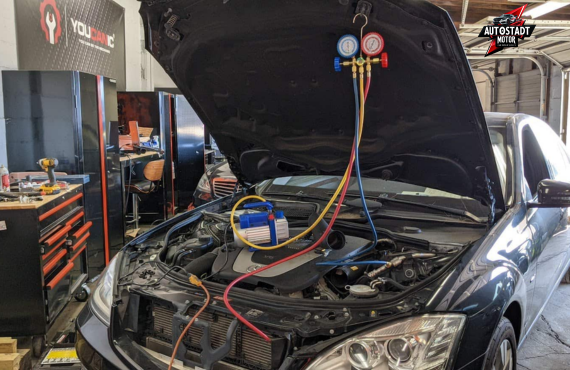
At AutoStadt Motor Services, Mazda owners in Dubai can have their car air conditioning system inspected to determine whether refrigerant service is required or another repair is responsible for the cooling problem. The goal is to restore effective cooling through appropriate diagnosis, correct refrigerant handling, and a repair solution suited to the vehicle.
Signs Your Car Needs Mazda AC Gas Refill
Recognizing early signs of reduced AC performance can help you arrange an inspection before the cooling system becomes less effective. Although some symptoms may indicate low refrigerant, a proper assessment is needed to confirm the cause.
1. The AC Blows Warm or Slightly Cool Air
One of the most common reasons drivers look for Mazda AC gas refill services is that the vents no longer produce the cold air they used to.
You may notice that the system works but the cabin remains warm, even when the temperature is set to its lowest level. Low refrigerant can contribute to this problem because the cooling circuit may no longer operate within its intended conditions.
Nevertheless, compressor problems, condenser restrictions, and electrical faults can create similar symptoms. An inspection helps determine whether refrigerant loss is responsible.
2. Cooling Takes Longer Than Usual
If your Mazda takes considerably longer to cool down after being parked outside, the AC system may not be performing efficiently.
Dubai’s outdoor temperatures can make the initial cooling demand substantial. However, if the system consistently struggles to reduce cabin temperature even after running for several minutes, it is worth checking.
Low refrigerant is one possible cause, but airflow restrictions and reduced condenser performance should also be considered.
3. The AC Cools Intermittently
An AC system that alternates between cold and warm air may have an underlying fault.
Refrigerant pressure issues, compressor control problems, faulty sensors, or electrical interruptions can affect cooling consistency. In some cases, the AC may perform differently at idle compared with normal driving.
Rather than repeatedly switching the system on and off, arrange a diagnostic inspection to identify the reason for the inconsistent performance.
4. Cooling Performance Drops During Traffic
Dubai’s stop-and-go traffic can reveal weaknesses that are less noticeable during uninterrupted driving.
If your Mazda’s AC feels colder while moving but becomes less effective at traffic signals, the condenser fan, airflow through the condenser, refrigerant pressure, or another system component may need attention.
This symptom does not automatically confirm low refrigerant. A technician should evaluate the system under appropriate operating conditions before recommending a refill.
5. The AC Runs but the Cabin Never Feels Comfortable
Sometimes the air coming from the vents feels moderately cool, yet the cabin temperature remains higher than expected.
This may be related to refrigerant charge, weak airflow, a dirty cabin filter, temperature-control issues, or heat entering the cabin through other sources.
An effective diagnosis considers the entire climate-control system instead of focusing on refrigerant alone.
6. The System Has Needed Repeated Refills
If your Mazda has required AC gas refills several times over a relatively short period, the cause of the refrigerant loss should be investigated.
Automotive AC systems are designed to operate as sealed circuits. Refrigerant should not routinely need topping up as part of ordinary maintenance.
Repeated refilling without checking for leakage may provide temporary cooling while leaving the underlying problem unresolved. A leak test and appropriate repair may be necessary before the system is recharged.
Why Choose AutoStadt Motor Services for Mazda AC Gas Refill
Finding a workshop that understands the difference between a refrigerant shortage and a mechanical or electrical fault can make the repair process more effective. AutoStadt Motor Services focuses on evaluating the AC system before recommending the required work.
Accurate AC System Diagnosis
Low refrigerant is only one possible explanation for poor cooling. Replacing or recharging the wrong component will not solve the problem.
A proper assessment can include refrigerant pressure checks, cooling performance evaluation, compressor operation, condenser inspection, airflow checks, and examination for visible signs of leakage.
This helps establish whether a Mazda AC gas refill is appropriate or whether another issue needs to be addressed first.
Correct Refrigerant Specification
Different Mazda models and model years may require different refrigerant types and specified charge quantities. The correct information should be confirmed from the vehicle’s AC service label or reliable manufacturer service data.
Using an incompatible refrigerant or an incorrect quantity can affect cooling performance and may damage system components. AutoStadt Motor Services can assess the vehicle’s requirements before carrying out refrigerant-related service.
Leak Detection Before Recharging
If the system has lost refrigerant, finding the source of the leak is an important part of the repair.
Potential leak locations include hoses, connections, seals, the condenser, compressor-related components, or the evaporator. The correct diagnostic method depends on the system and the suspected location.
Where a leak is confirmed, repairing it before recharging helps reduce the risk of the same problem returning.
Support for Different Mazda Models
Mazda vehicles vary in design, equipment, and AC specifications. A Mazda 3 may have different service requirements from a Mazda 6 or a Mazda CX-5.
The vehicle’s model year and installed system should therefore guide the inspection and service procedure.
Similarly, a Toyota Corolla, Nissan Altima, BMW 3 Series, or Mercedes-Benz C-Class may have different refrigerant specifications and diagnostic requirements. Vehicle-specific information is essential for appropriate AC servicing.
A Practical Approach to Repair Costs
Not every cooling problem requires a major component replacement.
For example, a restricted cabin filter may need routine maintenance, whereas a refrigerant leak could require repairing a damaged connection or replacing a faulty component. A compressor problem may involve more extensive work.
Identifying the cause first helps the owner understand the available repair options and avoid spending money on an unnecessary refill or replacement.
How Our Mazda AC Gas Refill Process Works
A reliable Mazda AC gas refill service involves more than connecting equipment and adding refrigerant. The system should be assessed, serviced according to its specifications, and tested after the work is complete.
Step 1: Discuss the Cooling Problem
The process begins by understanding the symptoms you have noticed.
The technician may ask whether the AC produces warm air continuously, becomes less effective in traffic, takes too long to cool the cabin, or has required repeated refills.
These details help narrow down the possible causes and guide the initial inspection.
Step 2: Inspect the AC System
The relevant components are checked according to the symptoms and vehicle design.
This may include the condenser, compressor, hoses, connections, cooling fan, cabin filter, and other accessible parts. The technician also looks for signs of damage, contamination, or refrigerant leakage.
The purpose is to identify problems that could affect the result of an AC recharge.
Step 3: Check Refrigerant Pressure and System Condition
Suitable diagnostic equipment is used to assess the system’s operating condition.
Pressure readings must be interpreted alongside ambient temperature, compressor operation, and other relevant factors. A single pressure reading is not always enough to determine the exact cause of poor cooling.
If refrigerant loss is suspected, the system may require further leak testing before proceeding.
Step 4: Identify and Address Any Leakage
If a leak is detected, its location and severity need to be established.
Depending on the fault, the repair may involve a hose, seal, connection, condenser, or another component. The exact solution depends on the confirmed source of refrigerant loss.
Repairing a leak before recharging is important because simply adding refrigerant does not correct a damaged component.
Step 5: Recover and Recharge Refrigerant Correctly
Where refrigerant service is appropriate, the technician follows the vehicle’s specified servicing procedure.
Refrigerant should be handled using suitable equipment, and the system should be charged to the manufacturer’s specified quantity. The correct refrigerant type must be confirmed for the individual Mazda.
Guessing the quantity or mixing incompatible refrigerants can compromise system performance.
Step 6: Test Cooling Performance
After servicing, the system is operated and checked again.
The technician can evaluate vent temperature, airflow, compressor operation, and other relevant indicators to determine whether cooling has improved as expected.
If the system still performs poorly, further diagnosis may be needed rather than assuming that additional refrigerant will solve the issue.
Step 7: Explain Any Further Maintenance
If the inspection reveals other concerns, these can be discussed with the owner.
For example, a dirty cabin filter, damaged condenser, faulty fan, or compressor-related problem may require separate attention. Addressing these issues appropriately can help maintain reliable cooling over time.
Mazda AC Maintenance Tips for Dubai Conditions
Regular attention to the AC system can help you identify developing problems before cooling performance deteriorates significantly.
First, pay attention to changes in vent temperature and airflow. If your Mazda starts taking longer to cool the cabin, arrange an inspection instead of waiting until the AC stops working altogether.
Second, check the cabin air filter according to the manufacturer’s maintenance recommendations. Dubai’s dust can contribute to filter contamination, reducing airflow and making the climate-control system feel less effective.
Third, do not ignore unusual noises when the AC operates. New clicking, grinding, or rattling sounds may indicate a mechanical issue that requires investigation.
It is also helpful to keep the condenser area free from excessive debris. Restricted airflow can affect heat transfer and reduce the system’s ability to remove heat from the refrigerant.
Finally, avoid treating refrigerant refill as a routine service that must be performed at fixed intervals regardless of condition. If the system is losing refrigerant, the cause should be identified. Preventive inspections and timely repairs are more useful than repeated recharging without diagnosis.
Frequently Asked Questions About Mazda AC Gas Refill in Dubai
1. How do I know if my Mazda needs an AC gas refill?
Common signs include weak cooling, warm air from the vents, inconsistent performance, or a system that takes longer than usual to cool the cabin. However, these symptoms can also result from a faulty compressor, condenser fan problem, blocked filter, or electrical issue. An AC inspection can establish whether the refrigerant charge is low and whether a leak or another fault needs attention before recharging.
2. How much does Mazda AC gas refill cost in Dubai?
The cost depends on the Mazda model, the required refrigerant type and quantity, and whether any additional repair is needed. A straightforward recharge may cost less than a service involving leak detection, hose replacement, condenser repair, or compressor work. The most useful first step is to have the system assessed so the workshop can identify the required service and explain any additional costs before proceeding.
3. How often should I refill my Mazda AC gas?
There is no universal refill interval for every Mazda. A properly functioning, sealed AC system should not routinely require refrigerant top-ups as part of ordinary maintenance. If the refrigerant level becomes low, a leak or another system issue may be responsible. Rather than scheduling repeated refills automatically, have the system inspected whenever cooling performance drops or refrigerant loss is suspected.
4. Can I refill my Mazda AC gas without repairing a leak?
Adding refrigerant without addressing a confirmed leak is generally not a lasting solution. The system may cool again temporarily, but refrigerant can escape and the same problem may return. A technician should identify the leak, determine the appropriate repair, and then recharge the system according to the vehicle’s specifications. This approach is more reliable than repeatedly topping up refrigerant without investigating why it is being lost.
5. Why is my Mazda AC still not cold after a gas refill?
If the AC remains warm after recharging, the problem may involve an incorrect refrigerant quantity, an unresolved leak, a compressor fault, condenser airflow, an expansion device, a temperature sensor, or another electrical or mechanical issue. It is also possible that the original problem was not related to refrigerant. A follow-up diagnosis can help identify the remaining fault rather than adding more refrigerant without confirming that it is needed.
Conclusion
Mazda AC gas refill can help restore cooling when a vehicle’s refrigerant charge is below the specified level. However, the best results come from understanding why cooling performance has declined and confirming that the system is suitable for recharging.
For Mazda drivers in Dubai, weak airflow, warm air, inconsistent cooling, and repeated refrigerant loss are reasons to arrange a proper inspection. The cause may be a refrigerant leak, a restricted condenser, a cabin filter issue, compressor trouble, or another AC system fault.
AutoStadt Motor Services offers AC inspection and repair support for Mazda owners seeking a practical solution to cooling problems. By checking the system, confirming the correct refrigerant specification, investigating suspected leaks, and testing performance after service, the workshop can help address the underlying issue rather than relying on a temporary fix.
If your Mazda is no longer delivering the cooling you expect, arrange an AC inspection to determine whether a refrigerant refill or a different repair is needed. Addressing the problem early can help restore cabin comfort and support dependable performance during Dubai’s demanding driving conditions.


Leave a Comment