
Mazda ac condenser change is an important service when your vehicle’s air conditioning system struggles to maintain cold air, develops a refrigerant leak, or stops cooling effectively during Dubai’s hot weather. The AC condenser plays a vital role in the cooling cycle by releasing heat from the refrigerant, allowing the system to produce cool air inside the cabin. When the condenser becomes damaged, blocked, or unable to transfer heat efficiently, the entire air conditioning system can suffer.
For Mazda owners, a faulty condenser can create problems ranging from gradually weaker cooling to a complete loss of air conditioning. Because the condenser is positioned near the front of the vehicle, it can be exposed to road debris, dust, sand, and other external damage. Over time, corrosion, damaged fins, leaking joints, or physical impact can also affect its performance.
In Dubai, dependable air conditioning is essential for comfortable daily driving. Long commutes, traffic congestion, high ambient temperatures, and extended periods of vehicle use can make an existing cooling problem particularly noticeable. Therefore, identifying condenser faults early can help prevent unnecessary strain on other AC components.
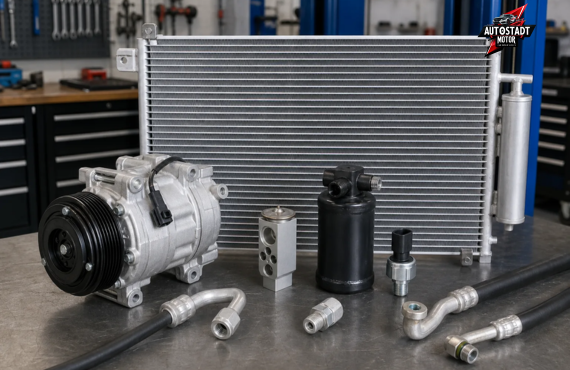
At AutoStadt Motor Services, Mazda AC condenser replacement begins with identifying the source of the cooling problem. Weak AC performance does not always mean the condenser needs replacement. A refrigerant leak, compressor fault, blocked airflow, or electrical issue may produce similar symptoms. A proper inspection helps determine whether a new condenser is necessary and which repair will provide a reliable solution.
Signs Your Car Needs Mazda AC Condenser Change
Recognizing condenser-related problems early can help Mazda owners arrange repairs before the air conditioning system stops working completely. The following symptoms deserve attention, although each can have more than one possible cause.
1. The AC Blows Warm or Slightly Cool Air
One of the most common signs of a potential condenser problem is reduced cooling performance. You may notice that the air coming from the vents is no longer as cold as it used to be, even when the temperature setting is at its lowest level.
A damaged condenser may struggle to release heat efficiently, while a leak can reduce the refrigerant charge. Both situations can affect the cooling cycle.
However, warm air alone does not confirm that the condenser has failed. The compressor, expansion device, refrigerant level, and other components must also be checked before deciding on a replacement.
2. Refrigerant Leaks Around the Condenser
The condenser contains refrigerant under pressure. If its metal tubing, connections, or joints become damaged, refrigerant may escape from the system.
A leak can gradually reduce cooling performance until the AC produces only mildly cool or warm air. In some cases, the leak may be difficult to identify because the refrigerant itself evaporates rather than leaving a conventional puddle.
A technician can inspect the condenser and associated connections using appropriate leak-detection methods. If the condenser is confirmed to be leaking and cannot be reliably repaired, replacement may be the most suitable option.
3. Cooling Becomes Worse During Dubai Traffic
If your Mazda’s AC performs better on the highway but struggles during slow-moving traffic, the condenser and its airflow should be inspected.
The condenser releases heat as air passes through its fins. When airflow is restricted by dirt, debris, damaged fins, or a cooling-fan problem, heat transfer can become less effective.
Nevertheless, this symptom does not automatically indicate a damaged condenser. The cooling fan, refrigerant pressures, and compressor operation may also need examination to determine the actual cause.
4. Visible Damage to the Condenser
Because the condenser is generally mounted near the front of the vehicle, it may be vulnerable to stones, road debris, minor collisions, and other physical impacts.
During an inspection, a technician may discover bent fins, damaged tubing, corrosion, or signs of refrigerant leakage. Although minor fin damage does not always require replacement, structural damage or a confirmed leak may make a new condenser necessary.
This is particularly relevant after front-end repairs or an accident, when the condenser and nearby AC components may have been affected.
5. The AC Stops Cooling After Working Normally
A sudden loss of cooling can indicate a developing fault within the air conditioning system.
If the condenser develops a significant leak, the refrigerant level may fall enough to prevent normal operation. Depending on the vehicle’s control system, protective mechanisms may prevent the compressor from operating when refrigerant pressure is outside the required range.
Other faults can produce similar symptoms, so the complete system should be diagnosed rather than replacing the condenser based on the symptom alone.
6. Repeated AC Gas Refills Do Not Solve the Problem
If your Mazda repeatedly needs refrigerant service, the underlying reason should be investigated.
A correctly functioning, sealed AC system should not regularly require refrigerant top-ups. Repeated loss may indicate a leaking condenser, hose, connection, evaporator, or another part of the refrigerant circuit.
Continuing to refill the system without finding the leak can increase maintenance costs while leaving the original fault unresolved.
Why Choose AutoStadt Motor Services for Mazda AC Condenser Change
Selecting a suitable workshop is about more than installing a replacement component. The quality of diagnosis, compatibility of parts, correct refrigerant handling, and final system testing all influence the result.
Accurate Diagnosis Before Replacement
At AutoStadt Motor Services, the aim is to identify the reason for poor cooling before recommending a condenser change.
The inspection may include checking AC performance, examining the condenser for visible damage, assessing the refrigerant circuit, and investigating related components. Depending on the symptoms, the technician may also check compressor operation, cooling fans, electrical controls, and pressure readings.
This process helps avoid replacing a condenser when the actual problem lies elsewhere.
Mazda-Specific Repair Considerations
Mazda vehicles vary by model, production year, engine configuration, and AC system design. A Mazda 3 may have a different condenser layout or replacement procedure from a Mazda 6 or Mazda CX-5.
Therefore, the replacement component and installation procedure should match the vehicle’s specifications. Correct fitment helps ensure that connections align properly and the condenser integrates with the existing system.
Appropriate Replacement Parts
A condenser should be selected according to the vehicle’s exact requirements. Incorrect dimensions, incompatible connections, or an unsuitable component can create installation difficulties or affect system performance.
Before replacement, it is important to verify the part’s compatibility with the specific Mazda model and year.
Attention to the Entire AC System
A failed condenser may not be the only issue requiring attention. If the system has been operating with a significant refrigerant leak, other faults may have developed or remained undetected.
AutoStadt Motor Services can assess related components and recommend additional work when the inspection supports it. This helps ensure that the repair addresses the wider cooling problem instead of focusing only on the visibly damaged part.
Reliable Cooling for Dubai Driving
A properly functioning AC system makes daily driving more comfortable, particularly during hot weather and congested journeys.
Whether you use your Mazda for commuting, family transport, or frequent long-distance travel, restoring effective cooling can make a meaningful difference. Professional diagnosis and appropriate repairs can also help reduce the likelihood of recurring problems.
How Our Mazda AC Condenser Change Process Works
A condenser replacement should follow a careful procedure to protect the refrigerant circuit and confirm that the cooling system works correctly after installation.
Step 1: Discuss the Symptoms
The process begins with understanding what the driver has experienced.
The technician may ask whether the AC produces warm air, cools intermittently, loses refrigerant, or performs poorly when the vehicle is stationary. Information about previous AC repairs or repeated gas refills can also help guide the inspection.
Step 2: Inspect the Condenser and AC Components
The condenser and accessible parts of the air conditioning system are examined for visible damage, corrosion, contamination, or signs of leakage.
The technician may also inspect the cooling fan, refrigerant lines, hose connections, compressor operation, and other components based on the symptoms.
This stage helps distinguish a condenser fault from a problem elsewhere in the system.
Step 3: Confirm the Need for Replacement
Before removing any parts, the technician determines whether the condenser is actually responsible for the fault.
If the condenser is leaking, structurally damaged, or no longer capable of operating as required, replacement may be recommended. If the issue is caused by a blocked airflow path or another component, a different repair may be more appropriate.
The customer should understand the identified problem and the recommended work before the repair proceeds.
Step 4: Recover Refrigerant Safely
Automotive AC refrigerant must be handled using appropriate equipment and procedures. It should not simply be released into the atmosphere.
When condenser replacement is required, the refrigerant is recovered using suitable service equipment before the system is opened. This allows the technician to work on the circuit while following the relevant safety and environmental requirements.
Step 5: Remove and Replace the Condenser
The damaged condenser is removed according to the vehicle’s service procedure. Depending on the Mazda model, access may require removing or moving certain front-end components.
The replacement condenser is checked for compatibility before installation. Connections, seals, and associated fittings should be inspected, and the correct replacement seals should be used where required.
Careful installation is important because a poorly seated connection or damaged seal can cause a new refrigerant leak.
Step 6: Check the System for Leaks
After installation, the AC circuit must be checked for leaks using suitable methods.
The system may require an appropriate evacuation process to remove air and moisture before it is recharged. The refrigerant type and specified charge amount must follow the vehicle’s requirements rather than being estimated.
Correct servicing helps protect system performance and reduces the risk of contamination.
Step 7: Recharge and Test Cooling Performance
Once the circuit has passed the necessary checks, it can be charged with the correct refrigerant quantity.
The technician then tests the AC system to assess cooling performance, compressor operation, airflow, and other relevant functions. The condenser area and connections are also checked for signs of leakage.
The aim is to confirm that the repair has addressed the original problem and that the system is operating as expected.
Factors That Affect Mazda AC Condenser Change Cost in Dubai
The cost of a Mazda AC condenser replacement depends on several factors, so an accurate estimate should be based on the vehicle and the confirmed fault.
Mazda model and year: Different models may use different condenser designs and replacement parts.
Parts selection: The cost may vary depending on the availability and type of compatible replacement condenser.
Labour and accessibility: Some vehicles require more disassembly to reach the condenser, which can increase labour time.
Additional repairs: Damaged seals, refrigerant lines, cooling fans, or other related components may require attention if the inspection identifies further faults.
Refrigerant service and testing: Proper refrigerant recovery, evacuation, recharging, and leak checks form part of the overall service requirements.
For these reasons, replacing the condenser should not be treated as a parts-only job. AutoStadt Motor Services can assess the vehicle and explain the required work before proceeding with the repair.
Frequently Asked Questions About Mazda AC Condenser Change in Dubai
1. How do I know if my Mazda AC condenser needs replacement?
Common warning signs include weak cooling, refrigerant loss, visible condenser damage, and cooling problems that persist despite previous AC servicing. However, these symptoms can also result from a faulty compressor, restricted airflow, or other AC faults. A professional inspection and suitable leak testing can help confirm whether the condenser is responsible and whether replacement is necessary.
2. How long does a Mazda AC condenser change take?
The time required depends on the Mazda model, condenser accessibility, condition of the surrounding components, and whether additional repairs are needed. Some replacements are relatively straightforward, while others require more extensive front-end disassembly. Refrigerant recovery, system checks, evacuation, recharging, and final performance testing also take time. The workshop can provide a more realistic estimate after inspecting your specific vehicle.
3. Can I drive my Mazda with a leaking AC condenser?
A leaking condenser may allow the AC system to lose refrigerant and eventually stop cooling. Although the loss of cabin cooling is the most obvious concern, the system should not be repeatedly operated or recharged without investigating the leak. If the vehicle has other symptoms, such as unusual noises or overheating, arrange an inspection promptly. A technician can determine whether the condenser is the cause and advise on the necessary repair.
4. Is AC gas refill enough, or do I need a new condenser?
An AC gas refill is not a permanent solution if refrigerant is escaping through a damaged condenser. If the condenser is confirmed to be leaking and replacement is required, the leak should be addressed before the system is properly recharged. On the other hand, weak cooling does not always mean the condenser has failed. Diagnosis is important because a fan, compressor, electrical issue, or restricted airflow may be responsible instead.
5. How much does Mazda AC condenser replacement cost in Dubai?
The price depends on the Mazda model, replacement condenser, labour requirements, refrigerant specification, and any additional components that need attention. A Mazda 3 may have different parts and labour requirements from a Mazda CX-5 or Mazda 6. The best way to obtain a useful estimate is to provide the vehicle’s model and year and arrange an inspection. AutoStadt Motor Services can then assess the fault and recommend the appropriate repair.
Conclusion
Mazda AC condenser change can restore dependable air conditioning when a damaged, leaking, or inefficient condenser is responsible for poor cooling. Since the condenser plays a key role in releasing heat from the refrigerant, its condition directly affects how effectively the AC system can cool the cabin.
However, weak cooling does not automatically mean the condenser needs replacing. Refrigerant leaks, compressor faults, cooling-fan problems, and other issues can produce similar symptoms. A proper inspection helps identify the cause and avoid unnecessary parts replacement.
For Mazda owners in Dubai, timely diagnosis is especially valuable when the AC begins losing performance during hot weather or busy traffic conditions. AutoStadt Motor Services offers AC inspection and repair support to help identify condenser problems, carry out appropriate replacement work, and check system performance after the repair.
If your Mazda’s AC is blowing warm air, repeatedly losing refrigerant, or struggling to keep the cabin cool, arrange a professional inspection to determine whether a condenser replacement is the right solution.


Leave a Comment