
Mazda coolant leak repair is essential when your vehicle begins losing coolant, showing temperature warnings, or leaving coloured fluid beneath the engine bay. Although a small coolant leak may not immediately affect driving performance, ignoring it can eventually lead to engine overheating, cooling-system damage, and costly mechanical repairs.
Mazda vehicles are designed to maintain a controlled engine temperature under different driving conditions. The cooling system achieves this by circulating coolant through the engine, radiator, hoses, thermostat, and other connected components. When any part of this system develops a leak, the engine may no longer receive adequate temperature regulation.
For Dubai drivers, a properly functioning cooling system is particularly important. High ambient temperatures, traffic congestion, frequent idling, and long journeys can place considerable demands on the engine cooling system. A leak that appears minor during a short drive may become more serious when the vehicle operates under greater thermal stress.
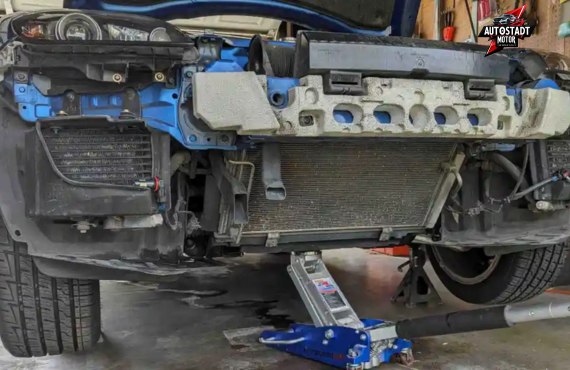
At AutoStadt Motor Services, Mazda coolant leak repair begins with identifying the source of coolant loss and determining whether other cooling components have been affected. Instead of simply topping up the coolant, a proper inspection helps establish whether the problem involves a radiator, hose, water pump, thermostat housing, reservoir, radiator cap, or another component.
Whether you drive a Mazda 3 for daily commuting, a Mazda 6 for regular travel, a Mazda CX-5 for family journeys, or a Mazda CX-9 for longer trips, addressing coolant loss early can help protect your engine and maintain dependable performance.
Signs Your Car Needs Mazda Coolant Leak Repair
Coolant leaks do not always produce the same symptoms. Some create visible puddles, while others allow coolant to escape slowly or leave residue around a component. Recognising the warning signs can help you arrange an inspection before the problem becomes severe.
1. Coolant Puddles Beneath Your Mazda
One of the easiest signs to notice is liquid beneath the front of your parked vehicle. Depending on the coolant formulation, the fluid may appear green, blue, pink, orange, or another colour. However, colour alone cannot confirm that the liquid is engine coolant.
A leak may originate from a radiator connection, coolant hose, water pump, expansion tank, or another part of the cooling system. In some cases, fluid travels along surrounding components before dripping onto the ground, making the original source difficult to identify.
If you regularly notice fresh fluid under your Mazda, arrange an inspection rather than assuming it is harmless condensation.
2. The Coolant Level Keeps Dropping
If you repeatedly need to add coolant to the reservoir, the system should be checked for leakage.
The coolant level can change slightly as the engine heats up and cools down, so checks should be made according to the manufacturer’s instructions, with the engine cold where specified. However, a consistent unexplained loss should not be ignored.
Simply topping up the reservoir may temporarily maintain the level, but it does not correct a leaking hose, damaged seal, cracked tank, or faulty component.
3. Engine Temperature Rises Above Normal
An engine temperature warning or gauge reading higher than usual is a serious sign.
When coolant escapes, the system may lose its ability to transfer heat effectively. If the coolant level becomes too low, overheating can develop rapidly, particularly in slow-moving traffic or during demanding driving conditions.
If your Mazda displays an overheating warning, pull over safely, switch off the engine when safe to do so, and arrange professional assistance. Do not continue driving in an attempt to reach a workshop if the engine is overheating.
4. A Sweet Smell Around the Vehicle
Some engine coolants have a distinctive sweet or chemical smell. If you notice this around the engine bay or inside the cabin, it may indicate a coolant leak.
A damaged hose or radiator connection can release coolant externally. Alternatively, a leak involving the heater core may cause unusual smells inside the vehicle, sometimes accompanied by window misting or dampness in the cabin.
Because coolant can be harmful if swallowed and should not be handled carelessly, avoid direct contact with leaking fluid.
5. Steam Coming From the Engine Bay
Steam emerging from beneath the bonnet can indicate that coolant is escaping onto hot engine components or that the cooling system is overheating.
This situation requires immediate attention. Stop somewhere safe and switch off the engine. Never open a hot radiator cap or pressurised coolant reservoir because escaping hot coolant or steam can cause severe burns.
Allow the vehicle to cool and arrange professional inspection before attempting further operation.
6. Visible Residue Around Hoses or the Radiator
Coolant may evaporate after escaping, leaving coloured or pale deposits around the leak location. These deposits can appear near hose joints, the radiator, the reservoir, or the water pump.
Although residue can help identify a possible leak, it does not always reveal the full extent of the problem. A professional inspection can help distinguish old residue from an active leak and determine whether the affected component needs repair or replacement.
Why Choose AutoStadt Motor Services for Mazda Coolant Leak Repair
Finding the correct workshop matters because cooling-system problems can have several causes that produce similar symptoms. Effective Mazda coolant leak repair requires more than identifying where fluid reaches the ground.
Accurate Cooling-System Diagnosis
At AutoStadt Motor Services, the diagnostic approach focuses on locating the actual source of coolant loss.
Depending on the symptoms, inspection may include the radiator, coolant hoses, clamps, expansion tank, radiator cap, water pump, thermostat housing, and relevant connections. Where appropriate, a cooling-system pressure test can help reveal leaks that are difficult to identify visually.
This approach reduces the risk of replacing a component that is not responsible for the problem.
Repair Recommendations Based on the Fault
Not every coolant leak requires a radiator replacement. A deteriorated hose, loose connection, damaged reservoir, or leaking seal may require a different repair.
Likewise, if the water pump is leaking or the radiator has developed a crack, the appropriate solution depends on the component’s condition and the vehicle’s requirements.
The goal is to recommend a repair that addresses the confirmed fault rather than relying on assumptions.
Attention to Dubai Driving Conditions
Driving in Dubai can involve high outdoor temperatures, extended traffic queues, and frequent periods of idling. These conditions make cooling-system reliability especially important.
Regular inspections can help identify deteriorating hoses, damaged connections, and other developing issues before they cause unexpected breakdowns.
Protection Against Further Engine Damage
Continuing to drive with a significant coolant leak can lead to overheating. Severe overheating may damage the cylinder head, head gasket, or other engine components.
By identifying the problem early, vehicle owners may avoid the additional costs and inconvenience associated with prolonged overheating. However, the extent of any existing damage must be assessed individually.
Support for Different Mazda Models
Cooling-system layouts and component requirements can vary between Mazda models and model years. A Mazda 3, Mazda 6, CX-5, CX-9, or MX-5 may require different inspection procedures or replacement parts.
Similarly, although Toyota, Nissan, BMW, and Mercedes-Benz vehicles also use liquid-cooled engines, their component designs and service requirements are not necessarily interchangeable. Vehicle-specific diagnosis is essential.
How Our Mazda Coolant Leak Repair Process Works
A structured repair process helps ensure that the leak is identified, corrected, and checked before the vehicle returns to regular use.
Step 1: Understand the Symptoms
The process begins with information about the coolant loss.
The technician may ask when the problem started, how frequently the coolant level drops, whether the temperature warning has appeared, and whether you have noticed puddles, unusual smells, or steam.
These details help establish the likely source and severity of the problem.
Step 2: Inspect the Cooling System
The relevant cooling-system components are examined for visible damage, wet areas, loose connections, corrosion, or dried coolant residue.
The inspection may include hoses, radiator joints, the coolant reservoir, thermostat housing, water pump area, and other accessible components.
The aim is to identify the source of leakage without overlooking related damage.
Step 3: Perform Appropriate Leak Testing
If the leak is not immediately visible, further testing may be needed.
A cooling-system pressure test, when suitable for the vehicle, can help reveal leakage under controlled conditions. Other diagnostic methods may be required if coolant loss is suspected but no external leak can be found.
If the engine shows signs of overheating or internal coolant loss, additional testing may be recommended to investigate possible internal engine problems.
Step 4: Determine the Required Repair
Once the cause is identified, the technician assesses the affected component.
A damaged hose may require replacement, while a radiator leak could call for radiator repair or replacement, depending on its condition. A leaking water pump, thermostat housing, or expansion tank may require a different solution.
The recommended repair should take account of the vehicle’s specifications and the condition of surrounding components.
Step 5: Replace or Repair the Faulty Component
The confirmed repair is then carried out using suitable components and the appropriate procedure.
The cooling system must be filled with coolant that meets the manufacturer’s requirements. Coolant types should not be selected based only on colour, as different formulations may have different specifications and compatibility requirements.
Where required, the system should also be bled correctly to remove trapped air that could interfere with circulation or temperature regulation.
Step 6: Check the System After Repair
After the repair, the cooling system should be checked again for leakage and correct operation.
Depending on the repair, this may include verifying the coolant level, inspecting the repaired area, checking temperature behaviour, and confirming that the system maintains appropriate operation.
If the engine previously overheated, additional assessment may be necessary to determine whether any secondary damage occurred.
Frequently Asked Questions About Mazda Coolant Leak Repair in Dubai
1. How much does Mazda coolant leak repair cost in Dubai?
The cost depends on the source of the leak, the Mazda model, the availability of replacement parts, and the labour required. A leaking hose or connection may be relatively straightforward to address, whereas a damaged radiator, water pump, or internal engine problem can require more extensive work. The most reliable way to establish the cost is to have the vehicle inspected so the repair estimate reflects the actual fault.
2. Can I drive my Mazda with a coolant leak?
Driving with a coolant leak is risky because the coolant level may fall until the engine can no longer maintain a safe operating temperature. Even a small leak can worsen during a longer journey. If the temperature rises above normal, a warning appears, or steam comes from the engine bay, stop safely and switch off the engine. Do not remove the radiator cap while the system is hot. Arrange an inspection before continuing to drive.
3. Why does my Mazda keep losing coolant without a visible puddle?
Coolant can escape slowly from a small external leak and evaporate on hot components before reaching the ground. In other cases, the source may be hidden behind a component or the coolant may be leaking internally. A pressure test and further diagnostic checks can help identify the cause. Repeated coolant loss should not be treated as normal consumption, and topping up alone is not a long-term solution.
4. Does a Mazda coolant leak always mean the radiator is damaged?
No. The radiator is only one possible source. Coolant hoses, clamps, the expansion tank, radiator cap, water pump, thermostat housing, and other connections may also leak. Internal engine problems can sometimes cause coolant loss without an obvious external leak. Proper diagnosis helps identify the affected component and prevents unnecessary radiator replacement when the actual issue is elsewhere.
5. How can I prevent coolant leaks in my Mazda in Dubai?
Follow the maintenance schedule recommended for your specific Mazda and have the cooling system inspected when servicing is due. Pay attention to falling coolant levels, visible residue, unusual smells, and temperature changes. Hoses and connections should be checked for deterioration, while coolant should be maintained according to the manufacturer’s specifications. Because Dubai’s operating conditions can place considerable demands on the cooling system, addressing early warning signs is particularly important.
Conclusion
Mazda coolant leak repair is essential when your vehicle shows signs of unexplained coolant loss, engine overheating, fluid beneath the car, or unusual smells around the engine bay. Although some leaks begin as relatively small faults, delaying the repair can expose the engine to excessive temperatures and potentially expensive damage.
The correct solution depends on the source of the leak. A damaged hose, radiator, water pump, reservoir, or thermostat housing may require a different repair, while unexplained coolant loss may need additional testing.
At AutoStadt Motor Services, the focus is on diagnosing the cooling-system problem, identifying the affected component, and recommending an appropriate repair for your Mazda.
If your Mazda is losing coolant or showing signs of overheating, arrange an inspection as soon as possible. Prompt attention can help protect the engine, maintain reliable cooling performance, and reduce the risk of a roadside breakdown in Dubai.


Leave a Comment