
Mercury AC repair is essential when your vehicle’s air conditioning system struggles to maintain a comfortable cabin temperature, produces warm air, or develops unusual noises during operation. In Dubai, where high outdoor temperatures and heavy traffic can put considerable demands on a car’s cooling system, a properly functioning AC is vital for comfortable daily driving.
Whether your Mercury experiences gradually weakening cooling, inconsistent airflow, or a complete AC failure, identifying the underlying problem is the first step toward a reliable solution. Simply adding refrigerant may not be enough because poor cooling can also result from a damaged compressor, a leaking condenser, a restricted cabin filter, electrical faults, or problems with the climate-control system.
At AutoStadt Motor Services, our approach to car AC repair focuses on identifying the cause of the problem before recommending the appropriate repair. This helps vehicle owners understand their options and avoid unnecessary component replacements.
Although Mercury is a discontinued American automotive brand, many of its vehicles remain in use. Models such as the Grand Marquis, Mountaineer, Milan, and Mariner may require maintenance as their components age. Because these vehicles differ in design and specification, the correct repair procedure depends on the particular model, model year, and installed AC system.
For Mercury owners in Dubai, timely air-conditioning maintenance can help restore cabin comfort, improve system performance, and reduce the likelihood of unexpected breakdowns during hot weather.
Signs Your Car Needs Mercury AC Repair
An automotive air-conditioning system can develop several warning signs before cooling stops completely. Recognizing these symptoms early can help you arrange an inspection before the problem becomes more complicated.
1. Mercury AC Blows Warm or Slightly Cool Air
One of the most common reasons to seek Mercury AC repair is insufficient cooling.
You may notice that the air coming through the vents feels cool initially but never reaches the desired temperature. Alternatively, the system may blow warm air even when the temperature control is set to its lowest setting.
Several faults can cause this problem, including low refrigerant, a refrigerant leak, reduced condenser efficiency, compressor problems, or a malfunctioning expansion valve.
In Dubai, weak cooling becomes particularly noticeable during afternoon journeys. However, the correct solution depends on testing the system rather than automatically assuming that it needs an AC gas refill.
2. AC Cooling Becomes Inconsistent
Does your Mercury produce cold air sometimes and warm air at other times?
Intermittent cooling can indicate a developing mechanical or electrical problem. A compressor that is not operating consistently, a faulty pressure sensor, an electrical connection issue, or a problem with the climate-control system may be responsible.
In some cases, cooling performance may also change as engine temperature or operating conditions change.
Because intermittent faults can be difficult to identify from symptoms alone, explain when the problem occurs to your technician. For example, mention whether the AC stops cooling while idling, during highway driving, or after the vehicle has been running for some time.
3. Unusual Noise When the AC Is Running
A healthy AC system should not suddenly develop loud grinding, rattling, or persistent squealing noises.
If an unfamiliar sound appears when you switch on the AC, the compressor, pulley, belt, or another related component may need inspection. The exact components involved depend on the vehicle’s configuration.
Ignoring a new mechanical noise is not advisable. If a component is deteriorating, continued operation may lead to additional damage.
At AutoStadt Motor Services, identifying the source of the noise is an important part of determining whether a repair or replacement is necessary.
4. Weak Airflow From the Dashboard Vents
Sometimes the air is reasonably cold, but very little of it reaches the cabin.
A dirty cabin air filter, restricted ventilation passages, a failing blower motor, or a problem with the blower control can reduce airflow.
This issue is different from a refrigerant shortage. Adding refrigerant will not resolve a blocked filter or a blower motor that cannot move sufficient air.
Therefore, an effective inspection should evaluate both cooling temperature and the volume of air coming from the vents.
5. Unpleasant Smell From the AC Vents
An unusual musty smell can make driving uncomfortable even if the system still produces cold air.
Moisture, accumulated dust, and contamination around the evaporator or ventilation system can contribute to unpleasant odours. A dirty cabin filter may also affect the air entering the passenger compartment.
The appropriate solution depends on the source. Replacing a filter, cleaning suitable components, or investigating moisture accumulation may be necessary.
If the smell resembles burning plastic or electrical insulation, switch off the AC and arrange an inspection promptly, particularly if smoke or other electrical symptoms are present.
6. Water or Refrigerant-Related Concerns
Water dripping beneath a car after using the AC is often normal condensation. However, water appearing inside the cabin, particularly around the passenger footwell, may indicate a blocked or improperly draining evaporator drain.
Refrigerant leaks are different and cannot reliably be identified by looking for an ordinary water puddle.
If you suspect a leak, professional inspection can help distinguish normal condensation from a genuine AC fault.
Why Choose AutoStadt Motor Services for Mercury AC Repair
Finding the correct solution requires more than replacing whichever component appears most likely to be faulty. AutoStadt Motor Services focuses on understanding the symptoms and evaluating the relevant AC components before recommending repair work.
Model-Specific Diagnosis
Mercury vehicles span different generations and mechanical designs. The AC configuration of a Grand Marquis may differ from that of a Mountaineer or Mariner.
Consequently, the technician should consider the model year, engine configuration, refrigerant specification, and system design before starting work.
This vehicle-specific approach helps ensure that the inspection and repair are appropriate for the car.
Comprehensive AC System Inspection
Automotive air conditioning relies on several interconnected components. These include the compressor, condenser, evaporator, expansion device, refrigerant lines, blower motor, cabin filter, and electrical controls.
A fault in one area can affect the performance of the entire system.
AutoStadt Motor Services can assess the components relevant to your vehicle’s symptoms and determine which areas require further investigation. This is especially useful when the AC has more than one problem.
Accurate Refrigerant Leak Detection
Refrigerant does not normally need frequent topping up during routine operation. If the system repeatedly loses refrigerant, the cause should be investigated.
Leaks may develop around hoses, seals, service ports, condenser connections, or other components. Suitable leak-detection methods can help locate the source before the system is recharged.
Repairing the leak, when confirmed, is generally more effective than repeatedly adding refrigerant without addressing the underlying issue.
Compressor and Condenser Repairs
The compressor circulates refrigerant through the AC system, while the condenser helps release heat from it.
If either component is not functioning correctly, cooling performance may deteriorate. However, similar symptoms can also result from electrical faults, airflow restrictions, or refrigerant-related issues.
Proper diagnosis helps determine whether the compressor or condenser actually needs repair or replacement.
Clear Repair Recommendations
Not every AC fault requires an expensive component replacement.
For example, a restricted cabin filter is a different problem from a failed compressor. Likewise, an electrical control issue requires a different repair from a refrigerant leak.
The objective is to identify the actual fault and recommend a practical solution based on the vehicle’s condition.
This approach is valuable for older Mercury vehicles, where the availability, condition, and cost of replacement parts may influence the repair decision.
How Our Mercury AC Repair Process Works
A structured diagnostic process helps ensure that the original complaint is investigated and the repair is checked afterward.
Step 1: Understand the Symptoms
The process begins by discussing the problem with the vehicle owner.
The technician needs to know whether the AC blows warm air, cools intermittently, produces unusual sounds, or has weak airflow. Information about when the problem occurs can help narrow down the possible causes.
For example, an AC that stops cooling at idle may require a different diagnostic approach from one that never produces cold air.
Step 2: Inspect the AC System
The relevant components are examined for visible damage, contamination, worn connections, and other warning signs.
Depending on the symptoms, the inspection may include the compressor, condenser, refrigerant lines, blower motor, cabin filter, and electrical connections.
The purpose is to establish which parts may be contributing to the problem rather than replacing components based on assumptions.
Step 3: Test Cooling and System Operation
The technician evaluates how the AC operates under suitable test conditions.
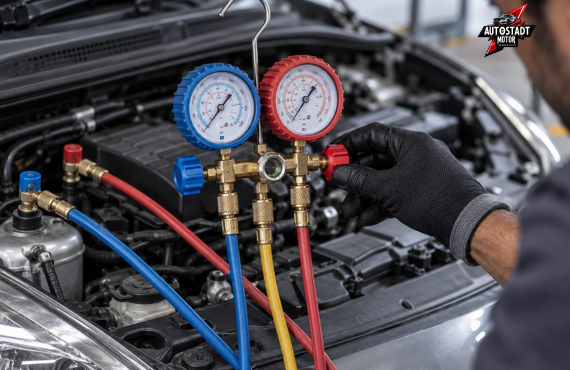
Air temperature, airflow, system pressures, compressor operation, and other relevant measurements can help identify abnormal performance. Diagnostic equipment may also be used when an electrical or control-system fault is suspected.
These checks provide a clearer understanding of the system’s condition.
Step 4: Locate Leaks or Identify Faulty Components
If refrigerant loss is suspected, suitable leak-detection procedures can be used to investigate the system.
If no leak is identified, the diagnosis may instead focus on compressor operation, condenser airflow, electrical controls, or another cause of weak cooling.
This stage is essential because different faults can produce nearly identical symptoms.
Step 5: Complete the Required Repair
Once the problem is identified, the necessary repair can be recommended.
Depending on the vehicle, this may involve replacing a cabin filter, repairing a refrigerant leak, addressing an electrical issue, or repairing or replacing a faulty compressor, condenser, or other component.
The correct refrigerant type and specified quantity must be used for the particular vehicle. Mixing refrigerants or using an unsuitable specification can damage the system and create safety concerns.
Step 6: Verify Cooling Performance
After the repair, the AC system should be tested again.
The technician checks whether the original complaint has been resolved and whether the system is operating as expected. Relevant checks may include vent temperature, airflow, compressor operation, and signs of refrigerant leakage.
This final assessment helps establish whether the repair has addressed the problem rather than merely producing a temporary improvement.
Maintaining Your Mercury AC in Dubai
Preventive maintenance can help identify problems before they develop into major repairs.
First, pay attention to gradual changes in cooling performance. If the cabin takes longer to cool than usual, arrange an inspection instead of waiting until the AC stops working completely.
Second, check the cabin filter according to the vehicle’s maintenance requirements. Dust and debris can restrict airflow, particularly in environments where vehicles regularly encounter dusty roads or construction areas.
Third, do not ignore unusual noises or recurring refrigerant loss. These symptoms may indicate a fault that will not disappear through routine use.
It is also sensible to keep the front of the vehicle’s condenser area free from excessive debris. Restricted airflow can affect heat transfer and reduce AC efficiency.
Finally, older vehicles may require additional attention to ageing seals, hoses, electrical connections, and other components. A well-maintained system can still develop faults, but timely inspection makes it easier to identify developing problems.
The same general principle applies to other vehicles, including the Toyota Camry, Nissan Altima, BMW 5 Series, and Mercedes-Benz E-Class. However, maintenance procedures and refrigerant requirements must always follow the specifications for the individual vehicle.
Frequently Asked Questions About Mercury AC Repair in Dubai
1. Why is my Mercury AC not blowing cold air?
Warm air can result from low refrigerant, a leak, compressor failure, a restricted condenser, electrical problems, or a malfunctioning expansion device. A cabin airflow issue may also make cooling seem inadequate. The best approach is to test the system and identify the actual fault before deciding whether a recharge, component repair, or replacement is necessary.
2. How much does Mercury AC repair cost in Dubai?
The cost depends on the specific Mercury model, the nature of the fault, the availability of suitable parts, and the labour required. A cabin filter replacement may be relatively straightforward, while compressor replacement or evaporator-related work can be more involved. An inspection by AutoStadt Motor Services can help establish the likely repair requirements before work proceeds.
3. Does my Mercury only need an AC gas refill?
Not necessarily. Low refrigerant can explain poor cooling, but it may also indicate a leak. Other problems, including compressor faults, condenser restrictions, or electrical issues, can produce similar symptoms. A proper diagnosis should establish whether refrigerant is low, why it is low if applicable, and whether the remaining components are working correctly.
4. Can I continue driving my Mercury if its AC is not working?
If the AC has simply stopped cooling and there are no other warning signs, the vehicle may still be mechanically drivable. Nevertheless, cabin comfort can become a significant concern during Dubai’s hot weather. If the AC produces a burning smell, smoke, severe mechanical noise, or signs of an electrical fault, switch it off and arrange an inspection. Any engine overheating or other serious warning requires separate immediate attention.
5. Can AutoStadt Motor Services repair older Mercury models?
Older Mercury vehicles can require more detailed diagnosis because their components may have aged and replacement parts may be less readily available than those for current models. The available repair options depend on the exact model, year, fault, and parts availability. Provide the vehicle details and describe the symptoms so the workshop can assess the appropriate diagnostic and repair options.
Conclusion
Mercury AC repair is important when your vehicle’s cooling system develops weak airflow, warm air, inconsistent performance, unusual noises, or unpleasant smells. In Dubai, where dependable cabin cooling is essential for everyday journeys, addressing these symptoms early can help prevent prolonged discomfort and potentially more extensive repairs.
However, the right solution starts with accurate diagnosis. A refrigerant refill will not resolve every AC problem, and replacing a compressor without confirming the fault can lead to unnecessary expense. Inspecting the relevant components and testing system performance provides a more reliable basis for deciding what needs attention.
AutoStadt Motor Services offers automotive AC inspection and repair support for drivers seeking a practical solution to cooling problems. Whether your Mercury Grand Marquis, Mountaineer, Milan, or Mariner has weak cooling or a more complicated AC fault, the recommended repair should be based on its specific system and condition.
If your Mercury is no longer keeping the cabin comfortable, arrange an AC inspection to identify the cause and determine the next steps. Timely attention can help restore cooling performance and make driving in Dubai more comfortable.


Leave a Comment