
Range Rover Suspension Repair is essential when your luxury SUV begins to feel unstable, uncomfortable, or unusually low on one side. Range Rover models are engineered for a combination of luxury, off-road capability, and confident road handling, but Dubai’s high temperatures, rough road surfaces, speed bumps, dust, and heavy daily traffic can gradually affect suspension components.
A healthy suspension system does much more than provide a comfortable ride. It helps maintain proper tyre contact with the road, supports braking stability, controls body movement, and keeps the vehicle predictable when cornering or changing lanes. When components such as air suspension bags, shock absorbers, control arms, bushings, compressors, or height sensors start to fail, ignoring the problem can lead to poor handling and more expensive repairs.
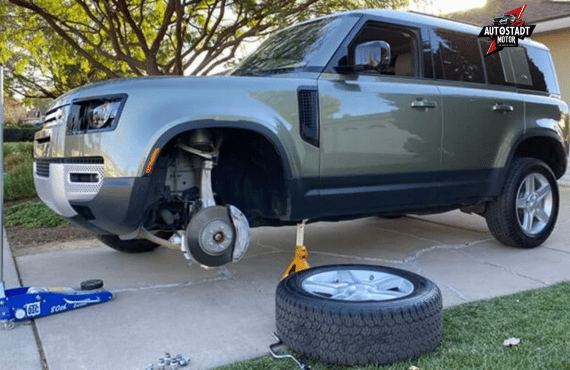
At AutoStadt Motor Services, we provide professional Range Rover Suspension Repair in Dubai with a focus on accurate diagnosis, quality workmanship, and practical repair solutions. Whether you drive a Range Rover Sport, Range Rover Vogue, Range Rover Velar, or Range Rover Evoque, our technicians can inspect the suspension system and identify the underlying cause rather than simply treating the visible symptom.
Signs Your Car Needs Range Rover Suspension Repair
Suspension problems do not always appear suddenly. In many cases, your Range Rover provides several warning signs before a major component completely fails. Recognizing these symptoms early can help prevent additional damage and improve driving safety.
1. Your Range Rover Sits Lower on One Side
One of the clearest signs of a suspension issue is when one corner of the vehicle appears lower than the others. This can be particularly noticeable after the vehicle has been parked for several hours.
On models equipped with air suspension, a low corner may indicate an air leak, damaged air spring, faulty valve block, or another problem within the electronic air suspension system. A professional Range Rover suspension inspection can determine whether the issue is mechanical or related to the air management system.
2. The Ride Becomes Unusually Bumpy
Range Rover vehicles are known for their refined ride quality. If you suddenly feel every road imperfection, speed bump, or uneven surface, the shock absorbers or other suspension components may be worn.
Weak dampers can allow excessive bouncing after bumps and make the vehicle feel less controlled. Therefore, unusual ride harshness should not simply be dismissed as normal wear.
3. Excessive Body Bouncing
A vehicle that continues bouncing after passing over a bump may have worn shock absorbers or dampers. The suspension should settle quickly after absorbing road movement.
If the body continues moving several times, the suspension may not be controlling the vehicle effectively. This can also contribute to reduced tyre grip, particularly during emergency braking or sudden steering movements.
4. Steering Feels Loose or Unstable
A loose steering sensation can sometimes be associated with worn suspension components. Damaged control arm bushes, ball joints, tie rods, or other related parts can affect wheel alignment and steering response.
If your Range Rover pulls to one side or feels unstable at higher speeds, it is advisable to have the suspension and wheel alignment checked together.
5. Uneven Tyre Wear
Inspect your tyres regularly. If one side of a tyre is wearing significantly faster than the other, the cause could involve suspension geometry, wheel alignment, worn bushings, or damaged components.
Uneven tyre wear should not be ignored because replacing tyres without correcting the underlying suspension or alignment issue may result in the same problem returning.
6. Warning Messages on the Dashboard
Modern Range Rover models use sophisticated electronic suspension systems. A fault with an air suspension compressor, height sensor, valve block, wiring, or control module may trigger a warning message.
When a suspension warning appears, professional diagnostic scanning is important. Replacing parts based only on a dashboard warning can be expensive if the actual fault lies elsewhere.
7. Unusual Suspension Noises
Clunking, knocking, squeaking, or creaking sounds from underneath the vehicle can indicate worn suspension components.
For example, a damaged bushing may produce a knocking sound over uneven roads, while worn links or joints can create noise during steering or acceleration. Getting the noise inspected early can help prevent secondary damage.
Why Choose AutoStadt Motor Services for Range Rover Suspension Repair
Choosing the right workshop is particularly important for premium vehicles such as Range Rover. Suspension systems can combine mechanical, hydraulic, pneumatic, and electronic components, so accurate diagnosis is often more important than simply replacing parts.
AutoStadt Motor Services provides a customer-focused approach to Range Rover Suspension Repair in Dubai. Our technicians inspect the complete suspension system to determine what is actually causing the problem.
Experienced Suspension Diagnostics
A suspension complaint can have several possible causes. For example, a vehicle sitting low could have an air spring leak, compressor problem, height sensor fault, or valve-related issue.
Instead of assuming the most expensive component has failed, our diagnostic process aims to identify the actual source of the problem.
Air Suspension Expertise
Many Range Rover models use electronically controlled air suspension systems. These systems offer excellent ride comfort and adjustable vehicle height, but they also require specialist attention when faults develop.
Our technicians can inspect air suspension components, compressor operation, air lines, valves, sensors, and related electronic systems to determine the appropriate repair.
Quality Replacement Components
Suspension performance depends heavily on the quality and compatibility of replacement parts. At AutoStadt Motor Services, we focus on suitable replacement components and professional installation to help restore reliable vehicle performance.
Depending on the vehicle and repair requirement, components may include air suspension bags, shock absorbers, control arms, bushings, stabilizer links, ball joints, compressors, or related parts.
Advanced Diagnostic Equipment
Modern luxury vehicles rely extensively on electronic control systems. Therefore, visual inspection alone may not always reveal the problem.
Diagnostic equipment can help identify stored fault codes and suspension-related system issues, allowing technicians to combine electronic information with physical inspection.
Dubai-Specific Experience
Dubai driving conditions can place additional stress on suspension components. High temperatures, frequent speed bumps, uneven road surfaces, construction areas, and dust can all contribute to vehicle wear.
That is why suspension maintenance should be considered part of responsible Range Rover ownership rather than something to address only after a major failure.
AutoStadt Motor Services also understands that suspension problems are not unique to Range Rover. Owners of BMW, Mercedes-Benz, Toyota, and Nissan vehicles can experience similar wear patterns, although the specific suspension systems and repair requirements differ between models.
How Our Range Rover Suspension Repair Process Works
A professional repair begins with diagnosis rather than immediate parts replacement. At AutoStadt Motor Services, our Range Rover Suspension Repair process is designed to identify the problem systematically.
Step 1: Initial Vehicle Inspection
We begin by discussing the symptoms you have noticed. This may include unusual ride height, warning messages, suspension noises, steering instability, or a change in ride comfort.
The vehicle is then inspected to identify visible signs of damage or abnormal wear.
Step 2: Suspension System Diagnosis
Our technicians examine important suspension components, including air springs, shock absorbers, control arms, bushings, joints, stabilizer links, and related components.
For air suspension vehicles, the system is also checked for possible air leaks and operational problems.
Step 3: Electronic Diagnostic Scan
If the Range Rover has a suspension warning or electronic fault, diagnostic equipment can be used to identify relevant fault codes and system information.
This helps narrow down the problem and prevents unnecessary component replacement.
Step 4: Component Testing
Once potential causes are identified, the relevant components are tested. For example, an air suspension issue may require checking the compressor, air pressure, valves, sensors, and air springs.
Mechanical components are also inspected for excessive movement, wear, cracks, or damage.
Step 5: Repair or Replacement
After the fault is confirmed, the required repair is carried out. Depending on the condition of the vehicle, this may involve repairing a component or replacing a damaged suspension part.
Our aim is to provide a practical repair solution based on the actual condition of your Range Rover.
Step 6: Suspension Calibration and Testing
After repairs, the suspension system may require calibration or electronic resetting depending on the model and the components replaced.
The vehicle is then tested to ensure that ride height, handling, suspension operation, and related systems are functioning correctly.
Step 7: Final Inspection
Before returning the vehicle, we perform a final inspection to verify the repair and check for related issues. This final step helps ensure that the original suspension complaint has been properly addressed.
Frequently Asked Questions About Range Rover Suspension Repair in Dubai
1. How much does Range Rover Suspension Repair cost in Dubai?
The cost of Range Rover Suspension Repair varies significantly depending on the model, suspension type, damaged component, and extent of the problem. A minor suspension component replacement will naturally cost less than replacing an air suspension compressor or multiple air springs.
For this reason, a professional inspection is the best way to determine the actual repair requirement. At AutoStadt Motor Services, we recommend diagnosing the vehicle before committing to major parts replacement.
2. How do I know if my Range Rover has an air suspension problem?
A Range Rover with an air suspension problem may sit lower than normal, lean to one side, fail to adjust its ride height, become unusually hard or soft, or display a suspension warning message.
You may also notice that the vehicle lowers after being parked for several hours. This can indicate a possible air leak, although other components can create similar symptoms.
Because several parts work together within the air suspension system, proper diagnosis is important before replacing anything.
3. Can I drive my Range Rover with a suspension warning?
It depends on the severity of the fault. If the vehicle remains stable and the warning is minor, you may be able to drive carefully to a workshop. However, a Range Rover that is sitting extremely low, leaning heavily, bouncing excessively, or showing serious handling problems should not be driven unnecessarily.
Continuing to drive with a serious suspension fault can affect steering, braking, tyre contact, and other components. If you experience major changes in vehicle stability, professional assistance should be arranged as soon as possible.
4. How often should Range Rover suspension be inspected in Dubai?
There is no single inspection interval that applies to every Range Rover because driving conditions, mileage, model, and suspension type all influence component life.
However, suspension inspection is particularly sensible when servicing a high-mileage vehicle, before long road trips, after driving over severe potholes, or whenever you notice unusual noises, ride-height changes, uneven tyre wear, or handling problems.
Regular inspections can identify worn components before they develop into larger and more expensive failures.
5. Why should I choose AutoStadt Motor Services for Range Rover Suspension Repair in Dubai?
AutoStadt Motor Services focuses on accurate diagnosis, professional workmanship, and customer-oriented service. Range Rover suspension systems can involve several interconnected mechanical and electronic components, making experience and proper diagnostic procedures important.
Our technicians inspect the suspension systematically, identify the likely cause, and recommend the necessary repair rather than encouraging unnecessary parts replacement. Whether your Range Rover requires suspension diagnostics, air suspension repair, shock absorber replacement, control arm work, or related suspension service, our team can assess the vehicle and explain the repair requirements clearly.
Conclusion
Range Rover Suspension Repair is an important part of maintaining the safety, comfort, handling, and premium driving experience expected from a Range Rover. Warning signs such as uneven ride height, excessive bouncing, suspension noises, unstable steering, uneven tyre wear, or dashboard warnings should never be ignored.
Dubai’s demanding driving environment makes regular suspension inspections even more valuable. Addressing a small suspension problem early can help prevent additional component damage and reduce the likelihood of an expensive repair later.
If your Range Rover is showing suspension problems, AutoStadt Motor Services can provide professional inspection, diagnostics, repair, and suspension maintenance in Dubai. From air suspension systems and shock absorbers to control arms, bushings, compressors, and electronic suspension components, the right diagnosis is the first step toward restoring your vehicle’s performance.
For reliable Range Rover Suspension Repair, choose a workshop that understands both modern luxury vehicle technology and the practical demands of Dubai roads. AutoStadt Motor Services is ready to help keep your Range Rover comfortable, stable, and road-ready.


Leave a Comment