
Mercedes suspension repair is essential when your vehicle develops unusual noises, uneven tyre wear, excessive bouncing, or changes in ride comfort and handling. Mercedes-Benz vehicles are engineered to deliver a refined driving experience, combining stability, comfort, and precise road control. However, suspension components gradually wear out, particularly when a vehicle is driven regularly over uneven roads, speed bumps, and busy city routes.
In Dubai, suspension maintenance deserves particular attention because daily commuting, frequent braking, parking manoeuvres, and exposure to high temperatures can place additional demands on vehicle components. A worn shock absorber or damaged suspension joint may initially produce only a slight noise, but ignoring the problem can eventually affect handling, tyre life, and driving comfort.
At AutoStadt Motor Services, Mercedes owners can have suspension-related concerns inspected to identify the underlying cause and determine the appropriate repair. Whether your vehicle needs shock absorber replacement, strut repair, suspension bush replacement, control arm inspection, or diagnosis of an air suspension fault, an accurate assessment is the first step towards restoring dependable performance.
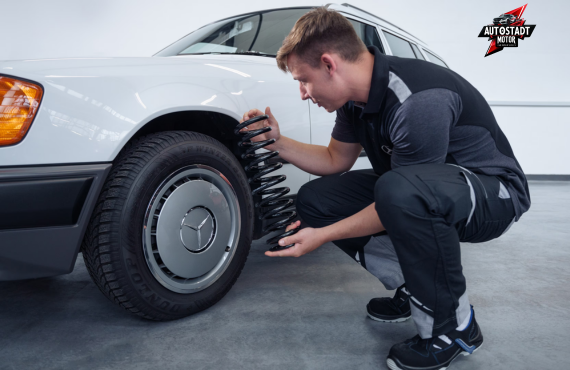
Mercedes-Benz suspension systems also vary between models. A C-Class may have a different configuration from an E-Class, GLC, GLE, or S-Class. Some vehicles use conventional springs and dampers, while selected models feature adaptive damping or air suspension. Consequently, the correct repair depends on the vehicle’s model, equipment, age, and actual condition.
Signs Your Car Needs Mercedes Suspension Repair
Suspension problems do not always appear suddenly. In many cases, the vehicle gradually becomes less comfortable or starts behaving differently on familiar roads. Recognising these changes early can help prevent further damage.
1. Unusual Knocking or Clunking Noises
A knocking sound from the front or rear suspension is one of the common reasons Mercedes owners seek professional inspection.
The noise may become noticeable when passing over speed bumps, driving on uneven surfaces, or turning into a parking space. Possible causes include worn control arm bushes, loose suspension connections, damaged stabiliser links, or deteriorated ball joints.
However, a noise alone does not confirm which component has failed. At AutoStadt Motor Services, the affected suspension area should be examined to distinguish between a worn part and another source of noise.
2. Excessive Bouncing After Bumps
Shock absorbers and dampers help control the movement of the vehicle’s springs. When their performance deteriorates, the car may continue bouncing after travelling over a bump.
You might notice that your Mercedes feels less settled on uneven roads or that passengers experience more movement than usual. Reduced damping can also affect tyre contact with the road and overall vehicle stability.
If the car repeatedly bounces or feels unsettled, arrange a suspension inspection rather than assuming that the issue is simply related to tyre pressure.
3. Uneven Tyre Wear
Suspension components influence wheel alignment and how tyres meet the road. Worn bushes, damaged control arms, incorrect alignment, or other faults can contribute to irregular tyre wear.
For example, one edge of a tyre may wear faster than the other, or the tread may develop an uneven pattern. Although alignment problems can also result from other causes, inspecting the suspension is important when unusual wear appears.
Early diagnosis may help prevent premature tyre replacement and identify a mechanical issue affecting the vehicle’s geometry.
4. Vehicle Pulling to One Side
If your Mercedes consistently pulls left or right on a reasonably level road, the problem should be investigated.
Possible causes include incorrect wheel alignment, uneven tyre pressure, brake-related problems, or worn suspension components. A damaged control arm or deteriorated bush may affect wheel positioning and steering behaviour.
Because several systems can produce similar symptoms, a complete assessment is more reliable than immediately adjusting the alignment.
5. Uneven Ride Height
A Mercedes that sits lower at one corner or appears noticeably uneven when parked may have a suspension problem.
On vehicles equipped with air suspension, possible causes include an air spring leak, a faulty compressor, a valve-block problem, or a height-sensor issue. Conventional suspension vehicles can also develop uneven ride height because of damaged springs or other mechanical faults.
If the vehicle drops overnight or repeatedly struggles to maintain its normal height, prompt diagnosis is advisable.
6. Steering Feels Loose or Less Precise
Suspension components contribute to the vehicle’s stability and steering response. When control arm bushes, ball joints, or other related parts become worn, the car may feel less precise during cornering or lane changes.
You might also notice vibration, excessive movement, or a clunk when accelerating or braking.
These symptoms should not be ignored, especially if they develop suddenly or affect your ability to control the vehicle. Stop driving if steering or handling becomes seriously compromised.
7. Warning Messages on the Dashboard
Some Mercedes models use electronic monitoring for adaptive suspension or air suspension systems. A dashboard warning may indicate that the system has detected a fault.
The message could relate to suspension height, electronic damping, a sensor, or another component. The exact meaning depends on the vehicle and warning displayed.
Professional diagnostic testing can help identify stored fault codes and determine whether the issue is electrical, mechanical, or pneumatic.
Why Choose AutoStadt Motor Services for Mercedes Suspension Repair
Choosing the right workshop involves more than replacing a visibly damaged component. A reliable repair should address the cause of the problem and confirm that the suspension operates correctly afterwards.
Mercedes-Focused Suspension Diagnosis
Mercedes vehicles use different suspension configurations across their model ranges. Identifying the correct system helps determine which inspection and repair procedures are appropriate.
AutoStadt Motor Services can assess the reported symptoms and inspect the relevant components before recommending a solution. This helps avoid replacing parts based on assumptions alone.
Inspection of Essential Suspension Components
Suspension performance depends on several interconnected parts. Depending on the vehicle, inspection may include shock absorbers, struts, springs, control arms, bushes, ball joints, stabiliser links, mounting points, and related hardware.
For air suspension models, the assessment may also include air springs, compressor operation, air lines, valves, and height sensors.
Examining the complete affected area can help identify additional wear that might otherwise be overlooked.
Appropriate Repair Recommendations
Not every suspension problem requires extensive replacement work.
For example, a worn stabiliser link may create knocking noises, whereas a leaking shock absorber can affect damping performance. An air suspension warning may require electronic diagnosis before any mechanical parts are replaced.
The aim is to recommend work that addresses the confirmed fault and suits the vehicle’s condition.
Comfort and Handling Considerations
Mercedes-Benz vehicles are designed with specific ride and handling characteristics. Using suitable replacement components and following the correct installation procedures helps maintain the intended driving experience.
This is particularly important for vehicles with adaptive damping or electronically controlled suspension, where component compatibility and system requirements matter.
Convenient Maintenance for Dubai Drivers
For drivers who rely on their Mercedes for commuting, family travel, or business appointments, unexpected suspension trouble can disrupt everyday plans.
Arranging an inspection when the first warning signs appear can help identify problems before they become more serious. AutoStadt Motor Services provides a repair option for Dubai motorists seeking assistance with suspension noise, ride-quality changes, and related mechanical concerns.
How Our Mercedes Suspension Repair Process Works
A structured inspection helps establish whether the problem comes from worn mechanical components, electronic controls, air suspension, or another vehicle system.
Step 1: Discuss the Symptoms
The process begins with the driver’s observations.
The technician may ask when the noise occurs, whether the vehicle sits lower than normal, if the ride has become harsher, or whether a warning appears on the dashboard.
Information about the vehicle’s model, year, mileage, and recent repairs can also help narrow down potential causes.
Step 2: Inspect the Suspension
The relevant suspension components are examined for visible damage, excessive movement, fluid leakage from dampers, worn bushes, damaged springs, or loose connections.
The inspection method depends on the symptoms and the suspension design. Any concerns affecting safe operation should be addressed before the vehicle returns to regular driving.
Step 3: Perform Diagnostic Testing Where Required
For Mercedes models with electronically controlled or air suspension systems, a mechanical inspection alone may not provide the full answer.
Diagnostic equipment may be needed to retrieve fault codes and assess relevant electronic systems. Air suspension concerns may require additional checks for leaks, compressor operation, pressure-related issues, or height-sensor faults.
Testing helps distinguish between a failed component and a related system problem.
Step 4: Confirm the Required Repair
After evaluating the findings, the technician determines which components require attention.
Depending on the vehicle, the repair may involve shock absorbers, struts, springs, control arms, bushes, stabiliser links, air springs, or another suspension component.
If wheel alignment has been affected by the repair or the original fault, alignment should also be assessed and corrected where necessary.
Step 5: Replace or Repair the Affected Components
The confirmed repair is then carried out using parts appropriate for the vehicle’s specification.
Suspension components often operate in pairs or as part of a larger assembly. Whether one part or multiple components should be replaced depends on their condition, manufacturer guidance, and the nature of the fault.
For air suspension or adaptive damping systems, any required calibration or system procedures should follow the applicable vehicle-specific requirements.
Step 6: Final Inspection and Road Testing
Once the repair is complete, the affected components and their connections should be checked again.
Where appropriate, the technician verifies ride height, suspension operation, warning messages, and wheel alignment. A road test may help confirm that the original noise, instability, or ride-quality concern has been resolved.
The purpose of this final stage is to assess the repair under suitable operating conditions rather than relying only on a visual inspection.
Mercedes Suspension Maintenance Tips for Dubai Conditions
Preventive maintenance can help identify developing suspension problems before they cause further inconvenience.
First, pay attention to changes in ride quality. If your vehicle starts bouncing more than usual, produces repeated knocks, or feels unstable over bumps, arrange an inspection.
Second, check tyre condition regularly. Uneven wear can provide an early indication of alignment or suspension issues, although tyre pressure and other factors should also be considered.
Third, avoid driving aggressively over speed bumps and potholes. Reducing speed before uneven surfaces helps limit unnecessary impact loads on tyres, wheels, and suspension components.
For Mercedes vehicles with air suspension, investigate changes in ride height or repeated compressor operation rather than repeatedly resetting warnings. These symptoms may indicate a leak or another system fault.
Finally, do not overlook related maintenance. A Toyota, Nissan, BMW, or Mercedes-Benz may have different suspension designs, but all vehicles benefit from timely inspection of tyres, steering, wheel alignment, and suspension components.
Frequently Asked Questions About Mercedes Suspension Repair in Dubai
1. How do I know if my Mercedes needs suspension repair?
Common indicators include knocking noises over bumps, excessive bouncing, uneven tyre wear, unusual ride height, steering instability, and suspension warning messages. However, these symptoms can have several possible causes. A professional inspection helps determine whether the problem involves shock absorbers, control arms, bushes, springs, air suspension, or another component.
2. How much does Mercedes suspension repair cost in Dubai?
The cost depends on the Mercedes model, the type of suspension fitted, the affected components, and the labour required. Replacing a worn stabiliser link may be less involved than repairing an air suspension system or replacing multiple suspension components. The vehicle should be inspected first so the repair estimate reflects the actual fault and the parts required.
3. Can I drive my Mercedes with worn shock absorbers?
Worn shock absorbers can reduce the vehicle’s ability to control body movement and maintain consistent tyre contact with the road. The level of risk depends on the severity of the wear and the symptoms. If the vehicle bounces excessively, feels unstable, or has a significant suspension fault, avoid continued driving until it has been assessed. Severe handling changes or damaged components require prompt attention.
4. Why does my Mercedes air suspension lower overnight?
A vehicle that lowers after being parked may have an air leak, a problem with an air spring, a valve-block fault, or another issue within the air suspension system. However, the cause cannot be confirmed from ride height alone. Diagnostic testing and leak inspection can help identify the problem before unnecessary parts are replaced.
5. Should I replace both Mercedes shock absorbers at the same time?
Replacing shock absorbers in pairs on the same axle is often recommended because matching damping performance helps maintain balanced handling. Nevertheless, the correct decision depends on the vehicle’s design, the condition of both units, and manufacturer guidance. A technician should inspect the suspension and explain whether paired replacement is appropriate for your Mercedes.
Conclusion
Mercedes suspension repair plays an important role in maintaining ride comfort, stability, handling, and tyre performance. Knocking noises, excessive bouncing, uneven tyre wear, unusual ride height, and suspension warnings are all reasons to investigate a possible fault.
For Dubai drivers, early diagnosis can help prevent a relatively straightforward repair from developing into a more complicated problem. Because Mercedes vehicles may use conventional, adaptive, or air suspension systems, the correct solution depends on the specific model and the results of a proper inspection.
AutoStadt Motor Services can help Mercedes owners investigate suspension concerns and identify the repair required. From worn shock absorbers and damaged control arms to air suspension faults, the priority should be accurate diagnosis, suitable replacement components, and post-repair checks.
If your Mercedes no longer feels as comfortable or stable as it should, arrange a suspension inspection to identify the cause and determine the next steps toward restoring dependable performance.


Leave a Comment