
Mitsubishi brake repair is an important service for Dubai drivers who want dependable stopping performance, especially when their vehicle is regularly exposed to heavy traffic, frequent braking, and long-distance driving. A Mitsubishi braking system is made up of several components that work together, including brake pads, brake discs or rotors, calipers, brake fluid, brake lines, and related hydraulic parts. When one component begins to wear or malfunction, braking performance can gradually change.
Many drivers do not notice brake problems immediately because the vehicle may continue to stop even when the braking system is no longer operating at its best. A slight squeal, a softer pedal, steering vibration, or increased stopping distance can be an early warning. Ignoring these signs may allow a relatively straightforward repair to develop into a more expensive brake-system problem.
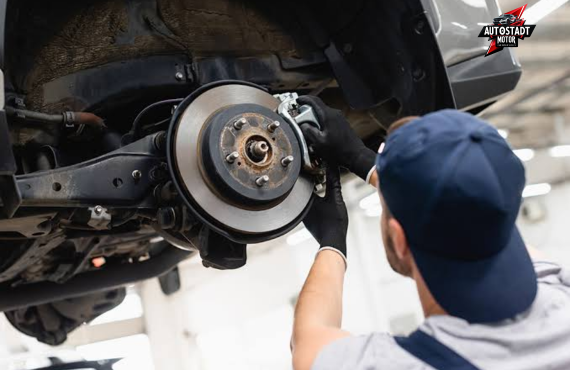
At AutoStadt Motor Services, Mitsubishi owners in Dubai can have their braking system inspected by technicians who focus on identifying the actual source of the problem before recommending repairs. Whether your Mitsubishi needs brake pad replacement, rotor inspection, caliper service, brake fluid replacement, or a more detailed brake-system diagnosis, proper inspection helps restore reliable braking performance.
Signs Your Car Needs Mitsubishi Brake Repair
Unusual Brake Noise
One of the most noticeable warning signs is a new sound when you press the brake pedal. A high-pitched squeal may indicate worn brake pads, while grinding can suggest that friction material has become severely worn.
However, not every noise means the same thing. Some sounds can come from dust, moisture, or surface conditions. That is why a proper inspection is more useful than simply replacing parts based on noise alone.
Brake Pedal Feels Soft or Spongy
A brake pedal should provide a reasonably consistent and controlled feel. If the pedal suddenly feels softer than usual or travels farther toward the floor, the braking system should be checked.
Possible causes can include air or moisture in the hydraulic system, low brake fluid, a hydraulic leak, or another brake-system fault. Continuing to drive without identifying the cause can compromise braking reliability.
Vehicle Pulls While Braking
If your Mitsubishi moves toward one side when braking, the issue may involve uneven brake-pad wear, a sticking caliper, rotor problems, tire-related issues, or other suspension and wheel components.
A professional inspection helps distinguish between a brake problem and another mechanical issue that produces similar symptoms.
Steering Wheel Vibrates During Braking
A vibration through the steering wheel while slowing down can be associated with uneven brake rotor surfaces, excessive runout, or other front-end problems. It is particularly noticeable during braking from higher speeds.
For example, a Mitsubishi Outlander used regularly on Dubai roads may experience different braking demands from a smaller Mitsubishi sedan used primarily for short city journeys. The correct diagnosis should therefore consider the vehicle’s usage and condition rather than relying only on mileage.
Increased Stopping Distance
If your vehicle seems to require more road space to stop than it previously did, do not ignore the change. Worn pads, damaged rotors, contaminated brake components, old brake fluid, tire problems, or other faults can contribute to reduced braking performance.
Early diagnosis can help prevent further wear and keep the braking system operating consistently.
Brake Warning Light Appears
A dashboard warning light should never be dismissed simply because the vehicle still drives normally. Depending on the model and system, a warning can indicate low brake fluid, a sensor-related issue, or another braking-system fault.
The safest approach is to have the vehicle scanned and physically inspected.
Why Choose AutoStadt Motor Services for Mitsubishi Brake Repair
Choosing a workshop for brake work is about more than replacing brake pads. A complete brake service should determine why the component has worn, whether related parts are affected, and whether the repaired system is functioning correctly.
AutoStadt Motor Services takes a diagnostic approach to Mitsubishi brake repair in Dubai. The vehicle is inspected to identify the condition of the braking components before the appropriate repair is recommended.
Detailed Brake System Inspection
A brake inspection can include checking pad thickness, rotor condition, caliper operation, brake fluid level and condition, brake lines, hoses, and other related components. This approach helps identify problems that may not be visible during a quick visual check.
Quality Replacement Components
Brake components need to be suitable for the specific Mitsubishi model. Using the correct specification for pads, discs, sensors, and other components helps maintain proper fitment and braking performance.
The requirements of a Mitsubishi Pajero, for instance, can differ considerably from those of a Mitsubishi Lancer because vehicle weight, brake configuration, driving conditions, and component specifications are not identical.
Repair Based on the Actual Problem
Not every brake noise requires a complete brake replacement. Likewise, replacing only the pads may not solve a problem if the rotors or calipers are also damaged.
AutoStadt Motor Services focuses on identifying the underlying issue so that the recommended work is relevant to the vehicle’s actual condition.
Experience With Different Vehicle Systems
Dubai workshops regularly deal with a wide range of vehicles. A driver might bring in a Mitsubishi one day and a Toyota Camry, Nissan Patrol, BMW 3 Series, or Mercedes-Benz C-Class the next. Each vehicle can have different brake-system configurations and service requirements.
This broad automotive experience is useful when diagnosing symptoms that may initially appear similar but have different causes.
How Our Mitsubishi Brake Repair Process Works
Step 1: Initial Inspection and Customer Discussion
The process begins by understanding what the driver has noticed. Information such as brake noise, pedal feel, vibration, pulling, warning lights, or recent brake work can provide useful diagnostic clues.
The technician then carries out an initial inspection to assess the braking system.
Step 2: Brake Component Examination
The brake pads, rotors, calipers, brake hoses, fluid, and related components are examined according to the vehicle’s condition and symptoms.
Where necessary, additional checks can be performed to determine whether the issue is mechanical, hydraulic, electronic, or related to another vehicle system.
Step 3: Identifying Wear and Damage
Brake wear is not always uniform. One pad may wear faster than another, a caliper may fail to release correctly, or a rotor may develop an uneven surface.
Finding these differences is important because simply installing new pads without addressing an underlying problem can result in premature wear again.
Step 4: Recommended Repair or Replacement
After the inspection, the appropriate repair is recommended. Depending on the diagnosis, this could involve brake pad replacement, brake disc replacement, caliper service, brake fluid service, brake-line repair, or another related repair.
The goal is to avoid unnecessary work while making sure safety-critical components receive proper attention.
Step 5: Installation and System Checks
Replacement components are installed according to the vehicle’s requirements. The braking system is then checked to ensure the components are operating correctly.
If brake fluid service is required, the system may also need appropriate bleeding to remove unwanted air and restore consistent pedal feel.
Step 6: Final Brake Performance Check
Before the vehicle is returned, the completed work should be reviewed and the braking system checked again. This final stage helps confirm that the original complaint has been addressed and that the vehicle is ready for normal road use.
Preventive Brake Maintenance for Mitsubishi Owners in Dubai
Regular inspection can be more effective than waiting until a serious symptom appears. Drivers who frequently travel through congested areas may use their brakes repeatedly during stop-and-go traffic, increasing friction and heat.
Likewise, drivers who travel on highways may notice vibration or braking instability more clearly when slowing from higher speeds.
Simple maintenance habits can help. Have the brake system inspected during routine servicing, pay attention to changes in pedal feel, check the brake fluid according to the manufacturer’s maintenance schedule, and investigate unfamiliar noises rather than assuming they will disappear.
It is also important to consider the condition of tires and suspension components. Braking performance depends on the complete contact and control system of the vehicle, not just the brake pads.
Mitsubishi Brake Repair for Different Driving Conditions
Dubai driving can involve several very different situations. A vehicle used primarily for short urban journeys experiences frequent acceleration and braking, while another Mitsubishi may spend considerable time on Sheikh Zayed Road or longer intercity routes.
Some owners also use Mitsubishi SUVs for heavier loads or desert-area driving. Dust and demanding conditions can increase the importance of regular inspections, although the exact maintenance requirements depend on the vehicle and usage.
For this reason, a good brake service should consider how the vehicle is actually driven rather than applying exactly the same maintenance approach to every Mitsubishi.
Frequently Asked Questions About Mitsubishi Brake Repair in Dubai
1. How do I know if my Mitsubishi needs brake repair or just brake pad replacement?
Brake pads are only one part of the braking system. If the pads are worn but the rotors, calipers, fluid, and other components are healthy, pad replacement may be sufficient. However, vibration, pulling, fluid leakage, uneven wear, or unusual pedal behavior can indicate additional problems.
A proper inspection at AutoStadt Motor Services can determine whether the issue is limited to the pads or involves other brake components.
2. How often should Mitsubishi brakes be inspected in Dubai?
There is no single mileage interval that applies to every Mitsubishi because brake wear depends on driving habits, traffic conditions, vehicle type, load, and component quality. Frequent stop-and-go driving can place different demands on the brakes compared with mostly highway driving.
It is sensible to have the brakes checked during scheduled maintenance and whenever you notice noise, vibration, pulling, a change in pedal feel, or increased stopping distance.
3. What causes Mitsubishi brakes to make a grinding or squealing sound?
Squealing can have several causes, including brake-pad wear, surface contamination, moisture, or the characteristics of the brake components. Grinding is more concerning because it can occur when friction material has become severely worn and metal components are contacting each other.
Because sounds can have multiple causes, continuing to drive and hoping the noise disappears is not a good diagnostic strategy. An inspection can identify the actual source.
4. Should I replace brake discs whenever I replace Mitsubishi brake pads?
Not necessarily. Brake discs should be assessed for thickness, surface condition, heat damage, cracking, scoring, and other relevant factors. If they remain within the required specifications and are in suitable condition, they may not require replacement.
However, severely worn or damaged discs can affect the performance and service life of new brake pads. The decision should therefore be based on inspection rather than an automatic replacement rule.
5. Where can I get Mitsubishi brake repair in Dubai?
AutoStadt Motor Services provides brake inspection and repair services for Mitsubishi vehicles in Dubai. Services can include brake diagnosis, pad replacement, disc inspection or replacement, caliper-related work, brake fluid service, and other brake-system repairs depending on the vehicle’s condition.
If your Mitsubishi is showing warning signs such as unusual brake noise, vibration, pulling, a soft pedal, or reduced stopping performance, arranging an inspection can help identify the problem before further component damage occurs.
Conclusion
Mitsubishi brake repair should never be treated as a routine parts replacement without first understanding the condition of the complete braking system. Brake pads, discs, calipers, fluid, hoses, and related components all contribute to safe and predictable stopping performance.
For Dubai drivers, regular inspection is particularly useful when a Mitsubishi is frequently driven in traffic, used for longer journeys, or subjected to demanding conditions. Recognizing early symptoms such as squealing, grinding, vibration, pulling, a soft pedal, or increased stopping distance can help prevent a minor issue from becoming a larger repair.
AutoStadt Motor Services offers professional Mitsubishi brake inspection and repair in Dubai with a focus on accurate diagnosis, appropriate replacement parts, and dependable workmanship. If your Mitsubishi is showing signs of brake wear or performance changes, a proper inspection is the practical first step toward restoring confident braking.


Leave a Comment