
MG evaporator change can become necessary when an MG vehicle develops an internal air-conditioning refrigerant leak, weak cabin cooling, unpleasant moisture-related symptoms, or repeated AC gas loss without an obvious leak under the bonnet. The evaporator is one of the most important components inside the vehicle’s air-conditioning system because it absorbs heat from the cabin air and helps produce the cold air that reaches the occupants.
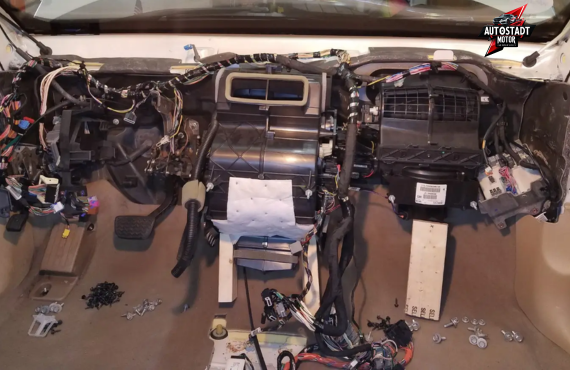
Unlike an AC component located in the engine compartment, the evaporator is generally positioned inside the HVAC housing behind the dashboard or within the cabin-side heating and cooling assembly. As a result, replacing it is more involved than simply changing an accessible hose, condenser, or compressor.
For MG owners in Dubai, a properly functioning air-conditioning system is particularly important. Vehicles are regularly exposed to high ambient temperatures, extended traffic, and frequent use of climate control. When the evaporator develops a refrigerant leak, the AC may gradually lose cooling performance even though the compressor and other components appear to be working.
At AutoStadt Motor Services, MG evaporator replacement begins with diagnosis rather than immediately removing dashboard components. This is important because weak cooling does not automatically mean that the evaporator has failed. Low refrigerant, a leaking hose, condenser damage, compressor problems, an expansion device fault, electrical issues, or restricted airflow can create similar symptoms.
A correct diagnosis helps ensure that the evaporator is replaced only when the evidence points toward an evaporator-related problem.
Signs Your Car Needs MG Evaporator Change
An evaporator problem can be difficult to identify because the component is hidden inside the HVAC system. However, several symptoms can indicate that professional AC inspection is necessary.
1. AC Gas Keeps Disappearing
One of the strongest reasons to investigate the evaporator is repeated refrigerant loss.
If your MG’s air conditioner works properly after an AC gas recharge but becomes warm again after some time, there may be a refrigerant leak somewhere in the system.
Technicians normally inspect accessible components first. If no external leak can be identified around the condenser, compressor, pipes, valves, or connections, attention may eventually turn toward the evaporator.
A recharge may restore cooling temporarily, but it does not repair the source of a refrigerant leak.
2. The AC Is Not Cooling Properly
An evaporator-related problem can contribute to poor cabin cooling.
You may notice that the air coming from the vents is only slightly cool rather than genuinely cold. In other cases, the system may initially provide reasonable cooling and then gradually become less effective.
However, weak AC should never be automatically blamed on the evaporator. Refrigerant charge, compressor operation, condenser efficiency, cabin filters, blower performance, and temperature controls should all be considered during diagnosis.
3. Refrigerant Leak Is Suspected Inside the HVAC Area
Because the evaporator is located within the HVAC housing, a leak may not produce the same obvious signs as an external AC pipe leak.
A professional technician can use appropriate diagnostic methods to determine whether refrigerant is escaping from the evaporator area.
This distinction matters because replacing an evaporator involves significantly more labour than repairing an easily accessible external connection.
4. Unusual Smell From the AC Vents
A strange smell coming from the ventilation system can sometimes be associated with moisture, contamination, or biological growth around the evaporator and HVAC drain area.
However, an unusual cabin smell does not automatically mean the evaporator is leaking.
For example, accumulated moisture, a dirty cabin air filter, or an obstructed drain can create unpleasant odours. Therefore, inspection is important before deciding on an evaporator replacement.
5. Excessive Moisture or Water-Related Symptoms
The AC system naturally removes moisture from cabin air. That moisture normally drains away through the HVAC condensate drain.
If the drainage system is restricted, water may accumulate around the HVAC housing or produce dampness in unexpected areas.
This can sometimes be confused with an evaporator problem. At AutoStadt Motor Services, the drainage system and surrounding HVAC components can be checked as part of a broader diagnosis.
6. AC Performance Changes During Long Drives
Some AC faults become more noticeable after the system has been operating continuously.
If your MG provides reasonable cooling for a short period but struggles during a longer drive, the problem may involve refrigerant pressure, airflow, compressor operation, evaporator temperature control, or another part of the climate-control system.
This is why describing exactly when the problem occurs can help the technician diagnose the vehicle more efficiently.
Why Choose AutoStadt Motor Services for MG Evaporator Change
Replacing an evaporator is not a job where unnecessary part replacement makes sense. Because the component is usually difficult to access, diagnosis should come before disassembly.
Diagnosis Before Dashboard Disassembly
The first objective at AutoStadt Motor Services is to determine whether the evaporator is actually the source of the problem.
The AC system may be inspected for refrigerant pressure, visible leaks, compressor operation, condenser condition, pipe connections, and other relevant factors.
If an external fault explains the problem, there may be no reason to remove the HVAC assembly.
Understanding the Entire AC System
The evaporator does not operate independently.
It works together with the compressor, condenser, expansion device, refrigerant lines, blower, HVAC housing, sensors, and cabin airflow system.
For example, a healthy evaporator cannot compensate for a compressor that is not producing the required pressure difference. Likewise, replacing the evaporator will not solve a problem caused by a blocked condenser or electrical control fault.
A complete system assessment therefore provides a more reliable repair decision.
Careful Interior and HVAC Work
Evaporator replacement can require access to areas behind the dashboard or within the HVAC module.
Interior trim, dashboard-related components, electrical connectors, HVAC housings, and other parts may need to be removed depending on the specific MG model.
Careful handling is important because rushing this stage can lead to broken clips, damaged trim, loose connections, or electrical problems.
Correct Replacement Component
The replacement evaporator should match the vehicle’s exact model and specification.
MG has produced multiple models and generations, and the HVAC configuration can vary. A suitable replacement therefore needs to be selected according to the vehicle rather than simply purchasing a generic component.
Complete AC System Testing
After installation, the job should not end when the new evaporator is physically in place.
The AC system needs to be restored, checked for leaks, evacuated where required, charged with the correct refrigerant specification, and tested for proper cooling performance.
This final stage helps confirm that the repair has addressed the original problem.
How Our MG Evaporator Change Process Works
Because the evaporator is located in a difficult-to-access area, a structured repair process is especially important.
Step 1: Discuss the AC Symptoms
The process starts by understanding what the MG owner has experienced.
The technician may ask when cooling became weak, whether the system has previously been recharged, how quickly the cooling disappeared, whether unusual smells are present, and whether the compressor appears to operate normally.
These details can help narrow down possible causes before major work begins.
Step 2: Inspect the AC System
The accessible AC components are inspected first.
This may include refrigerant lines, compressor connections, condenser areas, service ports, expansion-related components, and other visible sections of the system.
If a simple external leak is discovered, replacing the evaporator may not be necessary.
Step 3: Confirm the Evaporator Problem
If external components do not explain the refrigerant loss, further diagnostic testing can be performed to determine whether the evaporator is leaking.
This step is particularly valuable because evaporator replacement is more labour-intensive than many other AC repairs.
The goal is to establish a reasonable diagnosis before starting extensive disassembly.
Step 4: Prepare the Vehicle
Once evaporator replacement is confirmed, the vehicle is prepared for the repair.
Depending on the MG model, interior panels and dashboard-related components may need to be removed to gain access to the HVAC assembly.
Electrical connectors and associated components are handled carefully so they can be correctly restored during reassembly.
Step 5: Remove the Faulty Evaporator
The HVAC housing is accessed and the faulty evaporator is removed.
The surrounding components are inspected during this stage because the technician may discover additional issues such as damaged seals, contamination, blocked drainage, or other HVAC-related concerns.
If another problem is discovered, it is better to identify it while the system is already accessible rather than ignoring it and potentially requiring additional disassembly later.
Step 6: Install the Replacement Evaporator
The new evaporator is installed according to the vehicle’s configuration.
Relevant seals and connections are checked to ensure that the repaired system can operate correctly without introducing another leak.
The HVAC housing and removed interior components are then carefully reassembled.
Step 7: Vacuum and Recharge the AC System
Once the system has been restored, the air-conditioning circuit is prepared for operation.
The system can be evacuated as required and charged with the appropriate refrigerant quantity and specification.
Using the correct refrigerant and service procedure is essential because incorrect charging can negatively affect cooling performance and system operation.
Step 8: Test Cooling Performance
The final stage is performance testing.
The AC is operated and checked for cooling, airflow, temperature behaviour, unusual sounds, and signs of refrigerant leakage.
The goal is not simply to confirm that cold air is coming from the vents for a few minutes. The entire system should be assessed to ensure that the original problem has been properly addressed.
MG Evaporator Change and AC Maintenance in Dubai
Once an evaporator has been replaced, regular AC maintenance can help protect the rest of the climate-control system.
A clean cabin filter supports proper airflow through the HVAC system. Keeping the condenser area reasonably clean can also help the system release heat effectively. Additionally, unusual changes in cooling performance should be investigated instead of repeatedly relying on refrigerant top-ups.
Dubai’s driving environment makes this particularly relevant because air conditioning is often used for extended periods. A vehicle that spends considerable time in traffic can place sustained demand on its cooling and climate-control systems.
The same general principle applies to other vehicles. A Toyota may have a different HVAC configuration from an MG, while a Nissan, BMW, or Mercedes-Benz can use different components and diagnostic procedures. Vehicle-specific maintenance is therefore preferable to treating every AC system identically.
Frequently Asked Questions About MG Evaporator Change in Dubai
1. How do I know if my MG evaporator is leaking?
A recurring loss of refrigerant despite previous AC recharging is one of the main reasons to investigate the evaporator. Weak cooling, unusual HVAC symptoms, or evidence of a refrigerant leak that cannot be found in accessible components can also lead technicians to inspect the evaporator. However, these symptoms can have several causes, so an AC leak should be properly diagnosed before replacing the component.
2. Can an MG evaporator be repaired instead of replaced?
In most situations, replacement is considered when the evaporator itself has developed a significant refrigerant leak or physical failure. Because the component is located inside the HVAC assembly and can be difficult to access, attempting an unreliable repair may not provide a durable solution. The appropriate approach depends on the condition of the evaporator, the vehicle’s design, and the nature of the fault. A technician should inspect the system before recommending replacement.
3. How long does MG evaporator change take?
The time required can vary considerably depending on the MG model, HVAC design, access to the evaporator, and the amount of interior or dashboard disassembly required. Some vehicles provide easier access than others. Additional time may also be required for leak testing, system evacuation, refrigerant charging, reassembly, and final cooling checks. AutoStadt Motor Services can assess the specific vehicle and provide a more realistic estimate after inspection.
4. Is it safe to keep recharging the AC instead of changing the evaporator?
Repeatedly recharging an AC system without repairing an active refrigerant leak is not a proper long-term solution. The system may provide cold air temporarily, but the refrigerant can escape again. Continued operation with an unresolved fault can also make it harder to determine the underlying problem. If your MG repeatedly loses refrigerant, the source of the leak should be identified rather than relying on repeated gas refills.
5. How much does MG evaporator change cost in Dubai?
The price depends mainly on the MG model, replacement evaporator, accessibility of the component, labour involved in removing interior or dashboard components, and whether additional AC parts require attention. An evaporator replacement is generally more involved than a simple gas recharge or external hose repair. For this reason, an accurate estimate should be based on the actual vehicle and confirmed diagnosis. AutoStadt Motor Services can inspect the AC system and determine what work is genuinely required before proceeding.
Conclusion
MG evaporator change is a specialized air-conditioning repair that requires more than simply restoring refrigerant. When an MG repeatedly loses AC gas, develops weak cooling, or shows symptoms associated with an internal HVAC leak, the evaporator may need to be investigated.
However, evaporator replacement should not be based on guesswork. Similar symptoms can come from the compressor, condenser, refrigerant lines, expansion components, electrical controls, airflow restrictions, or other HVAC faults. Accurate diagnosis therefore plays a major role in avoiding unnecessary dashboard removal and additional expense.
For MG owners in Dubai, reliable cabin cooling is an important part of everyday driving. A properly repaired AC system can provide consistent comfort while helping prevent repeated refrigerant loss and unnecessary future repairs.
AutoStadt Motor Services provides professional MG AC inspection and evaporator replacement support, with attention to diagnosis, correct component installation, refrigerant-system checks, and final cooling performance.
If your MG keeps losing AC gas or the air conditioner no longer provides the cooling you expect, getting the system professionally inspected can help identify the actual fault and determine whether an evaporator replacement is genuinely required.


Leave a Comment