
Mercedes electrical repair is essential when your vehicle develops warning lights, starting difficulties, malfunctioning electronics, or unexpected electrical failures. Modern Mercedes-Benz vehicles rely on sophisticated electronic systems to manage engine performance, transmission operation, safety features, lighting, climate control, and driver assistance. When one component develops a fault, it can sometimes affect several other functions.
For Mercedes owners in Dubai, electrical problems can be particularly inconvenient during daily commuting, heavy traffic, and long journeys. A vehicle that fails to start in a parking area or displays repeated dashboard warnings can disrupt your schedule and may indicate an underlying issue that needs professional attention.
However, not every electrical fault requires a new battery or expensive control module. A weak battery, loose connection, damaged wire, faulty sensor, blown fuse, or charging-system problem can sometimes produce similar symptoms. Accurate diagnosis is therefore important before replacing any component.
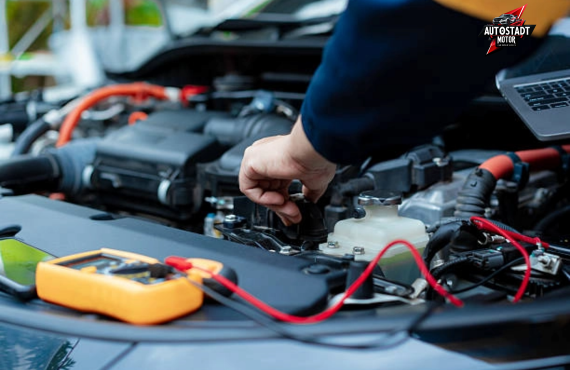
At AutoStadt Motor Services, Mercedes electrical repair focuses on identifying the source of the fault and determining the appropriate solution. Whether you drive a Mercedes-Benz C-Class, E-Class, GLE, GLC, or another model, a systematic inspection can help restore reliable operation and reduce the risk of recurring electrical problems.
Signs Your Car Needs Mercedes Electrical Repair
Electrical faults do not always appear as a complete system failure. Sometimes, the first indication is a small change in how a vehicle starts, responds, or operates. Recognizing these symptoms early can help you arrange an inspection before the problem becomes more disruptive.
1. Dashboard Warning Lights Appear Unexpectedly
Modern Mercedes-Benz vehicles use electronic monitoring systems to alert drivers when something requires attention. Warning messages relating to the battery, engine management, braking systems, airbags, or other vehicle functions should not be ignored.
Occasionally, a low battery voltage or charging-system fault can trigger several warnings at once. Nevertheless, it is important not to assume that every warning is caused by the battery.
A professional diagnostic scan can help identify stored fault codes and determine which systems need further investigation. If a safety-related warning appears, follow the vehicle’s instructions and avoid driving if the vehicle may be unsafe.
2. Mercedes-Benz Has Difficulty Starting
A clicking sound, slow engine cranking, or a vehicle that does not start can indicate an electrical problem.
Possible causes include a weak battery, corroded battery terminals, a faulty starter motor, damaged wiring, or a problem with the charging system. In some cases, an immobilizer or key-recognition issue may also prevent the vehicle from starting.
Replacing the battery without checking the rest of the system may not solve the problem. AutoStadt Motor Services can assess the starting and charging systems to help establish the actual cause.
3. Electrical Accessories Stop Working Properly
Power windows, central locking, interior lighting, seat adjustments, infotainment screens, and other electrical accessories depend on correctly functioning circuits and control units.
If several accessories stop working together, the problem may involve a shared power supply, fuse, wiring connection, or electronic module. If only one function is affected, the fault may be limited to that component or its circuit.
A structured inspection helps distinguish between these possibilities and prevents unnecessary parts replacement.
4. Battery Keeps Losing Charge
A Mercedes-Benz battery that repeatedly becomes discharged deserves attention.
Although batteries naturally deteriorate over time, repeated discharge can also result from an alternator problem, poor electrical connections, or excessive current consumption while the vehicle is parked.
Modern vehicles contain numerous electronic systems, so identifying an abnormal battery drain may require specialized testing. Simply installing another battery could lead to the same issue if the underlying fault remains unresolved.
5. Lights Flicker or Become Unusually Dim
Flickering headlights, inconsistent interior lighting, or unusual brightness changes can indicate an electrical supply problem.
Potential causes include battery deterioration, charging-system irregularities, poor grounding, damaged wiring, or a fault within the lighting circuit.
Because reliable lighting is important for safe driving at night, these symptoms should be checked promptly. The technician should test the relevant electrical supply rather than replacing bulbs without confirming the cause.
6. Sensors or Electronic Features Behave Erratically
Mercedes-Benz vehicles may include parking sensors, reversing cameras, electronic stability systems, driver assistance features, and other technology-dependent functions.
If a feature stops working or displays an intermittent warning, the problem may involve a sensor, wiring connection, power supply, software-related issue, or control module.
Environmental conditions and physical damage can also affect certain sensors. A diagnostic assessment helps determine whether the issue is electrical, mechanical, or related to the component’s operating conditions.
Why Choose AutoStadt Motor Services for Mercedes Electrical Repair?
Mercedes-Benz electrical systems can be complex, which makes a careful diagnostic process particularly valuable. The right repair should address the underlying problem rather than simply remove a warning message or replace a suspected component.
Accurate Electrical Fault Diagnosis
AutoStadt Motor Services approaches Mercedes electrical repair by investigating the symptoms and available diagnostic information.
Depending on the problem, this may involve scanning relevant control modules, checking battery condition, testing charging voltage, inspecting fuses, and examining wiring and electrical connections.
Diagnostic trouble codes provide useful information, but they do not always identify the failed component directly. Additional testing may be needed to confirm the cause.
Mercedes-Specific Diagnostic Approach
Different Mercedes-Benz models use different electrical architectures and equipment. A fault affecting an older C-Class may require a different diagnostic approach from an issue involving a newer GLE or E-Class.
The model year, installed options, vehicle configuration, and affected system all influence the investigation. Using the correct diagnostic procedure helps reduce guesswork and supports more appropriate repairs.
Repairing the Root Cause
An electrical warning can be a symptom rather than the actual fault.
For example, a control module may report low voltage because the battery or alternator is not supplying adequate power. Replacing the module without investigating the voltage problem could result in unnecessary expense.
Similarly, a recurring fuse failure may indicate a short circuit or an overloaded circuit that needs investigation.
The objective is to identify why the problem occurred and recommend a repair that addresses the cause.
Careful Wiring and Connection Inspection
Wiring problems can be difficult to locate because damage may be hidden behind panels, inside connectors, or within sections of the engine bay.
Loose terminals, corrosion, damaged insulation, and poor grounding can interrupt electrical signals or power delivery.
A thorough inspection of the relevant circuit can help locate these faults and determine whether a connection repair, wiring repair, or component replacement is appropriate.
Support for Different Vehicle Makes
Although this service focuses on Mercedes-Benz, electrical diagnostics are also important for other modern vehicles. BMW, Audi, Toyota, and Nissan models each use their own electronic systems and diagnostic requirements.
Understanding that vehicle-specific procedures matter helps avoid the assumption that every electrical fault can be repaired using the same method.
How Our Mercedes Electrical Repair Process Works
A dependable repair process involves more than connecting a scanner and clearing fault codes. The objective is to understand the complaint, test the relevant systems, complete the repair, and verify the result.
Step 1: Discuss the Symptoms
The first step is to understand what the driver has experienced.
The technician may ask whether the vehicle fails to start, displays warning messages, loses battery charge overnight, or experiences intermittent accessory failures.
It is also useful to explain when the problem occurs. For example, a fault that appears after the vehicle has been parked for several hours may require a different investigation from one that occurs while driving.
Step 2: Perform an Initial Electrical Inspection
The next stage involves checking the relevant electrical components.
Depending on the symptoms, the inspection may include the battery terminals, battery condition, alternator connections, visible wiring, fuses, grounding points, and associated components.
This initial assessment can identify obvious problems before more detailed testing begins.
Step 3: Scan the Relevant Electronic Systems
Modern Mercedes-Benz vehicles contain multiple electronic control units. A suitable diagnostic tool can retrieve fault codes and system information from supported modules.
The results help identify which systems have reported problems and guide the next stage of testing.
However, fault codes should be interpreted carefully. A code relating to a sensor, for instance, does not automatically mean the sensor itself has failed. Its wiring, power supply, connector, or communication circuit may also need checking.
Step 4: Test the Suspected Circuit or Component
Once the likely fault area is identified, further testing helps confirm the diagnosis.
This may include battery load testing, charging-system checks, voltage measurements, continuity testing, or inspection of a particular sensor or electrical connection.
For intermittent faults, additional investigation may be necessary because the problem might not be present throughout the inspection.
Step 5: Recommend the Appropriate Repair
After the fault has been confirmed as far as possible, the necessary repair can be recommended.
Depending on the findings, the work may involve battery replacement, alternator repair, starter motor service, fuse or wiring repairs, sensor replacement, or further diagnosis of an electronic control module.
Where programming, coding, or module adaptation is required, compatibility with the specific Mercedes-Benz model should be considered before the work proceeds.
Step 6: Complete the Repair and Verify Operation
Following the repair, the affected system should be tested again.
The technician can check whether the original symptoms have disappeared, whether the relevant electrical values are within the expected range, and whether the system operates correctly.
Where appropriate, diagnostic codes can be reviewed again to determine whether further investigation is necessary. Clearing a code alone is not proof that the underlying problem has been resolved.
Mercedes Electrical Maintenance Tips for Dubai Drivers
Preventive maintenance cannot eliminate every electrical fault, but it can help identify developing problems and reduce avoidable breakdowns.
Monitor battery condition. If your Mercedes cranks slowly or repeatedly requires jump-starting, arrange a battery and charging-system test. Do not assume that a new battery is the only possible solution.
Respond to warning messages. Dashboard warnings provide useful information about vehicle systems. Check the owner’s manual and arrange an inspection when necessary, especially when warnings relate to braking, steering, or other safety-critical functions.
Avoid unprofessional wiring modifications. Poorly installed accessories, incorrect connections, and unsuitable electrical equipment can cause circuit faults or battery drain. Any additional equipment should be installed correctly and be compatible with the vehicle.
Investigate repeated fuse failures. A fuse that repeatedly blows should not simply be replaced again and again. The circuit may have an underlying electrical fault that needs to be identified.
Keep service records. Information about previous battery replacements, repairs, warning messages, and installed accessories can help a technician investigate recurring problems more efficiently.
Dubai’s hot environment can also place additional demands on vehicle batteries. Regular battery checks are particularly useful as batteries age, although temperature alone does not explain every electrical problem.
Frequently Asked Questions About Mercedes Electrical Repair in Dubai
1. How do I know if my Mercedes needs electrical repair?
Common signs include repeated battery discharge, difficulty starting, flickering lights, malfunctioning windows, electronic warning messages, or accessories that stop working unexpectedly. Several symptoms may occur together, but their causes can differ. A professional inspection and appropriate diagnostic testing can help determine whether the fault involves the battery, alternator, wiring, starter motor, sensor, or an electronic control unit.
2. What causes electrical problems in Mercedes-Benz vehicles?
Electrical problems can develop for several reasons, including an ageing battery, charging-system failure, damaged wiring, corroded connections, faulty sensors, blown fuses, or electronic module issues. Some faults may also follow an unsuccessful accessory installation or physical damage. Because similar symptoms can result from different causes, diagnosis should be based on testing rather than replacing parts through guesswork.
3. Can a weak battery cause multiple Mercedes dashboard warnings?
Yes. Low or unstable battery voltage can sometimes affect multiple electronic systems and trigger several warning messages. However, not every group of warnings is caused by the battery. Charging faults, communication problems, and failures in individual systems can produce similar symptoms. Battery and charging-system testing, combined with a suitable diagnostic scan, helps determine whether low voltage is responsible.
4. How much does Mercedes electrical repair cost in Dubai?
The cost depends on the type of fault, the model and year of the vehicle, the accessibility of the affected component, and whether parts or specialist programming are required. A battery or connection issue may be relatively straightforward, while wiring faults and control-module problems can require more extensive diagnosis. AutoStadt Motor Services can assess the reported symptoms and identify the required work before an appropriate repair estimate is prepared.
5. Can I drive my Mercedes if an electrical warning light appears?
That depends on the warning and the vehicle’s behaviour. Some warnings indicate a minor issue, while others can relate to braking, steering, engine operation, or charging-system failure. Read the dashboard message and follow the vehicle’s instructions. If the vehicle loses power, becomes difficult to control, overheats, or displays a serious safety warning, stop somewhere safe and arrange assistance rather than continuing to drive.
Conclusion
Mercedes electrical repair requires a systematic approach because modern Mercedes-Benz vehicles depend on interconnected electronic systems for starting, charging, safety, comfort, and performance. A warning light, recurring battery problem, malfunctioning accessory, or intermittent starting fault may have several possible causes, making accurate diagnosis essential.
Rather than replacing parts based on symptoms alone, the better approach is to inspect the relevant components, test the affected circuits, interpret diagnostic information, and verify the repair afterwards.
AutoStadt Motor Services offers Mercedes electrical inspection and repair support for Dubai drivers seeking a practical solution to vehicle electrical problems. From battery and charging-system concerns to wiring faults, sensors, and electronic malfunctions, the appropriate repair begins with identifying the source of the issue.
If your Mercedes-Benz is displaying unexplained warnings, struggling to start, or experiencing recurring electrical failures, arranging a professional inspection can help you understand the problem and make an informed repair decision.


Leave a Comment