
Nissan mechanic services are essential when your vehicle starts showing unusual noises, warning lights, poor performance, or handling problems. Nissan vehicles are known for practical engineering, comfortable driving, and dependable performance, but like any car, they require proper maintenance and timely repairs to remain reliable.
From routine oil changes and brake inspections to advanced engine diagnostics, transmission repairs, suspension work, and electrical troubleshooting, choosing the right specialist can make a significant difference. A qualified Nissan technician understands that different Nissan models can have different mechanical requirements, so diagnosis should always come before replacing parts.
For Dubai car owners, professional maintenance is particularly important. Heavy traffic, frequent stop-and-go driving, long highway journeys, and demanding weather conditions can gradually place additional stress on engines, cooling systems, air conditioning components, brakes, and suspension parts.
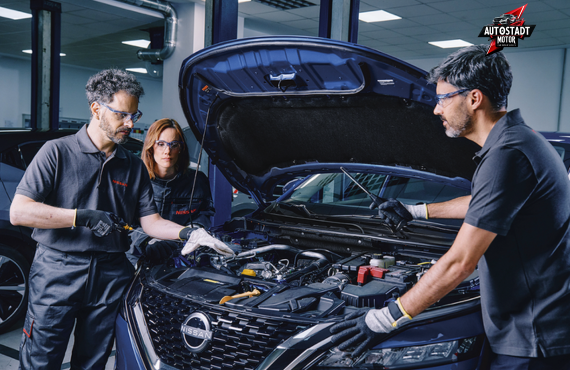
At AutoStadt Motor Services, Nissan owners can receive comprehensive vehicle inspection, maintenance, diagnostics, and repair services under one roof. Rather than treating every vehicle problem the same way, our technicians identify the underlying cause and recommend the appropriate solution for your specific Nissan model.
Whether you drive a Nissan Patrol, Altima, X-Trail, Pathfinder, or another Nissan vehicle, regular servicing can help prevent small mechanical problems from developing into expensive repairs.
Signs Your Car Needs a Nissan Mechanic
Many Nissan problems begin with symptoms that may appear minor. However, ignoring these warning signs can allow the underlying issue to become more complicated.
1. Nissan Engine Is Losing Performance
A noticeable reduction in acceleration, rough idling, hesitation, or unusual engine behavior can indicate several potential problems. Faulty sensors, ignition components, fuel delivery issues, air intake problems, or engine management faults can all affect performance.
For example, a Nissan Patrol that feels noticeably weaker when accelerating may need a diagnostic inspection rather than simply an oil change. A professional Nissan mechanic can use diagnostic equipment and physical inspection to narrow down the actual cause.
2. Check Engine Light Appears
The check engine light should never be ignored simply because the vehicle continues to drive normally. It can be triggered by anything from an emissions-related fault to a sensor problem or a more serious engine issue.
Professional computer diagnostics can identify stored fault codes. However, reading the code is only the first step. An experienced technician should investigate why the code appeared instead of replacing components unnecessarily.
3. Transmission Shifting Feels Different
Delayed gear engagement, harsh shifting, slipping, unusual transmission noises, or hesitation can indicate a transmission-related problem.
Automatic transmissions depend on correct fluid condition, hydraulic pressure, electronic controls, and properly functioning mechanical components. Continuing to drive with obvious transmission symptoms may increase repair costs.
If your Nissan Altima or Pathfinder begins shifting differently, having it inspected early can help determine whether the issue is related to maintenance, electronics, fluid condition, or internal transmission components.
4. Braking Performance Changes
A soft brake pedal, vibration while braking, squealing, grinding, or increased stopping distance should be treated seriously.
Brake pads and discs naturally wear over time, but braking problems can also involve calipers, brake fluid, wheel components, or hydraulic parts. A complete brake inspection allows the technician to identify the source before it becomes a safety concern.
5. Unusual Suspension Noise
Dubai roads can include speed bumps, uneven surfaces, and heavy traffic conditions that gradually affect suspension components.
Knocking, clunking, excessive bouncing, uneven tire wear, or a vehicle that pulls to one side may indicate worn suspension or steering components. Nissan suspension inspection can help identify issues with control arms, bushings, shock absorbers, wheel alignment, and related parts.
6. Air Conditioning Is Not Cooling Properly
A properly functioning AC system is essential for comfortable driving in Dubai. If the air conditioner takes too long to cool the cabin, produces warm air, makes unusual sounds, or has inconsistent cooling, professional inspection is recommended.
The problem could involve refrigerant level, compressor operation, condenser airflow, electrical controls, or other AC components. Simply adding refrigerant without finding the reason for the loss may not solve the problem permanently.
7. Battery or Electrical Problems
Slow engine cranking, flickering lights, electrical accessories behaving strangely, or repeated battery discharge can point toward an electrical problem.
A Nissan mechanic can test the battery, alternator, charging system, wiring, and relevant electrical components to determine whether the battery itself is faulty or whether another component is causing the issue.
Why Choose AutoStadt Motor Services for Nissan Mechanic Services
Choosing a workshop is not simply about finding the cheapest repair estimate. Proper diagnosis, technician experience, equipment, replacement parts, and workmanship all influence the long-term result.
Experienced Nissan Diagnostics
At AutoStadt Motor Services, our approach begins with understanding the vehicle’s symptoms. Diagnostic equipment can provide valuable information, while visual and mechanical inspection helps confirm the actual problem.
This combination is important because a fault code does not automatically mean that the corresponding component needs replacement.
Complete Nissan Maintenance
Nissan servicing can include much more than changing engine oil. Depending on the vehicle and mileage, maintenance may involve:
- Engine oil and filter replacement
- Brake inspection and servicing
- Transmission inspection
- Battery and charging-system testing
- Cooling-system checks
- AC inspection
- Suspension and steering inspection
- Tire and wheel checks
- Fluid inspections
- Computer diagnostics
- Preventive maintenance
A maintenance schedule should be based on the Nissan model, mileage, age, driving conditions, and manufacturer’s recommendations.
Model-Aware Repair Approach
A Nissan Patrol used primarily for long-distance driving may require a different maintenance focus than a Nissan X-Trail used for daily city commuting.
Likewise, maintenance requirements can differ between older and newer vehicles. That is why AutoStadt Motor Services focuses on the actual condition of the vehicle instead of applying the same repair process to every Nissan.
Quality Parts and Proper Workmanship
Using inappropriate or low-quality replacement parts can create additional problems. During repairs, technicians should select components compatible with the vehicle and the specific repair requirement.
The same principle applies to fluids, filters, belts, brake components, suspension parts, and electrical components.
Transparent Recommendations
A professional workshop should explain what has been identified, what requires immediate attention, and what can reasonably be monitored.
At AutoStadt Motor Services, our goal is to help Nissan owners understand their vehicle’s condition so they can make informed maintenance decisions.
How Our Nissan Mechanic Process Works
A good repair process should be systematic rather than based on guesswork.
Step 1: Vehicle Assessment
The process begins when you bring your Nissan to the workshop. Our technician discusses the symptoms you have noticed, including when the issue occurs, how long it has been happening, and whether anything recently changed.
Details such as whether a noise occurs during acceleration, braking, turning, or cold starts can provide useful diagnostic clues.
Step 2: Initial Inspection
The vehicle is visually and mechanically inspected for obvious signs of wear, leaks, damage, or abnormal operation.
Depending on the complaint, technicians may examine the engine bay, underneath the vehicle, tires, brakes, suspension, fluids, belts, hoses, and electrical components.
Step 3: Computer Diagnostics
If the Nissan has warning lights or electronic faults, diagnostic equipment can be used to communicate with the vehicle’s control modules.
Fault codes, sensor information, and other available data can help identify areas requiring further investigation.
Step 4: Identify the Root Cause
This is one of the most important stages. Instead of immediately replacing a part because it appears related to a fault code or symptom, the technician checks whether that component is genuinely responsible.
For example, poor engine performance could be caused by several different systems. Proper diagnosis reduces unnecessary part replacement and helps target the actual fault.
Step 5: Repair and Replacement
Once the issue is confirmed, the required repair is carried out using suitable replacement components and correct workshop procedures.
Depending on the repair, this may involve replacing worn parts, correcting electrical faults, servicing fluids, repairing leaks, or addressing mechanical components.
Step 6: Testing After Repair
The vehicle should be tested after the repair to make sure the original symptom has been resolved.
In some cases, this involves a road test. In others, technicians may perform additional diagnostic checks, system tests, or inspections to confirm normal operation.
Step 7: Maintenance Guidance
Finally, you can receive recommendations regarding future maintenance. This helps you understand which components should be monitored and when another inspection may be appropriate.
Frequently Asked Questions About Nissan Mechanic in Dubai
1. How often should I take my Nissan to a mechanic in Dubai?
The ideal service interval depends on the Nissan model, engine, mileage, vehicle age, and driving conditions. Regular maintenance should follow the vehicle’s recommended service schedule, while older or heavily used vehicles may require more frequent inspections.
Dubai’s stop-and-go traffic and extensive use of air conditioning can also make routine checks particularly valuable. In addition to scheduled servicing, Nissan owners should arrange an inspection whenever they notice a new warning light, noise, vibration, fluid leak, or performance change.
2. What Nissan models can a Nissan mechanic service?
A professional Nissan workshop can typically work on a broad range of Nissan vehicles, including sedans, SUVs, crossovers, and other models.
This may include vehicles such as the Nissan Patrol, Nissan Altima, Nissan X-Trail, Nissan Pathfinder, and Nissan Sunny. However, the exact diagnostic and repair requirements depend on the model year and engine configuration.
At AutoStadt Motor Services, technicians can assess the vehicle based on its specific mechanical and electrical systems rather than relying on a generic repair approach.
3. How do I know whether my Nissan needs a major repair?
Major repairs are usually associated with significant symptoms such as severe overheating, major fluid leaks, persistent engine misfires, transmission slipping, serious braking problems, or abnormal mechanical noises.
However, a symptom alone does not automatically mean the vehicle needs a major repair. Professional diagnosis is necessary to determine the severity of the problem.
Getting an issue inspected early is often beneficial because some major repairs begin with relatively small warning signs.
4. Can a Nissan mechanic diagnose electrical problems?
Yes. Modern Nissan vehicles contain numerous electronic control systems, sensors, modules, and electrical components. Problems can therefore involve the battery, alternator, wiring, sensors, control modules, or other electrical systems.
A proper electrical diagnosis normally combines diagnostic scanning with voltage testing, visual inspection, and component testing. Simply replacing the battery may not resolve a recurring electrical problem if the actual fault lies elsewhere.
5. Why is preventive Nissan maintenance important in Dubai?
Preventive maintenance allows potential problems to be identified before they develop into larger failures. Regular inspection of fluids, brakes, tires, cooling systems, AC components, suspension, battery, and engine-related systems can help maintain vehicle reliability.
This is particularly useful for drivers who spend significant time in traffic or regularly travel longer distances around the UAE.
For Nissan owners, preventive servicing can also provide a better understanding of the vehicle’s condition and help reduce unexpected workshop visits.
Conclusion
A reliable Nissan mechanic can play an important role in keeping your vehicle safe, efficient, and dependable on Dubai roads. From routine servicing and brake maintenance to engine diagnostics, transmission inspection, AC repair, suspension work, and electrical troubleshooting, professional attention can prevent minor issues from becoming expensive problems.
Nissan vehicles such as the Patrol, Altima, X-Trail, and Pathfinder are built for different driving needs, so maintenance should be based on the specific vehicle rather than a one-size-fits-all approach.
If your Nissan is showing unusual symptoms or is due for scheduled maintenance, AutoStadt Motor Services provides a practical option for professional Nissan diagnostics, servicing, and repair in Dubai. With proper inspection, accurate diagnosis, quality workmanship, and timely maintenance, you can keep your Nissan performing reliably for the road ahead.


Leave a Comment