
Nissan electrical repair is essential when a vehicle begins showing warning lights, starting problems, malfunctioning electronics, or unexplained battery drain. Modern Nissan models rely on interconnected electrical systems to control everything from engine management and charging to lighting, safety features, climate control, infotainment, sensors, and driver-assistance functions. When one component develops a fault, the symptoms can sometimes appear in completely different parts of the vehicle.
For Dubai car owners, electrical problems should not be ignored simply because the vehicle still starts and drives. A weak battery, damaged wiring connection, faulty alternator, blown fuse, defective sensor, or communication issue can gradually become a more expensive problem. In addition, Dubai traffic, frequent short journeys, high electrical loads from air conditioning, and demanding daily driving can place additional stress on a vehicle’s electrical components.
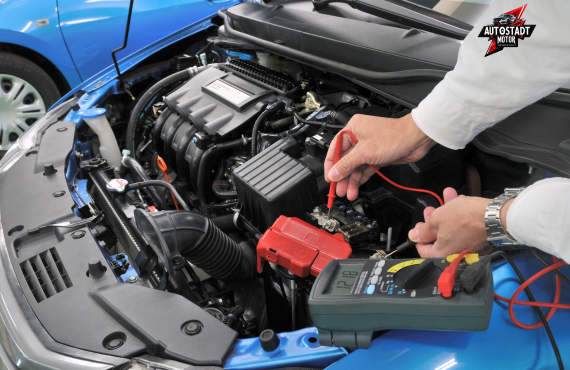
At AutoStadt Motor Services, Nissan electrical repair is approached through proper diagnosis rather than unnecessary parts replacement. Whether you drive a Nissan Patrol, Altima, X-Trail, Sunny, or another Nissan model, identifying the actual source of an electrical fault is the first step toward a dependable repair.
Understanding Nissan Electrical Repair
A Nissan’s electrical system consists of much more than its battery. The battery provides starting power, while the alternator maintains electrical supply when the engine is running. Fuses and relays protect circuits, wiring distributes power, and control modules communicate with sensors and other electronic systems.
Depending on the Nissan model and equipment level, the vehicle may also contain multiple electronic control units, parking sensors, cameras, ABS components, body control modules, electronic throttle systems, and sophisticated engine-management technology.
Consequently, an electrical symptom does not always identify the failed component. For example, a vehicle that refuses to start could have a weak battery, poor terminal connection, starter problem, immobilizer issue, charging fault, or an electrical communication problem.
That is why professional Nissan electrical diagnostics are important before replacing components.
Signs Your Car Needs Nissan Electrical Repair
Difficulty Starting or Intermittent Starting
One of the most noticeable electrical problems is inconsistent starting. Your Nissan may start normally in the morning but struggle later in the day, or the starter may click without properly cranking the engine.
Possible causes include a weak battery, corroded terminals, starter motor problems, poor grounding, charging-system faults, or damaged electrical connections.
If the problem occurs repeatedly, checking the battery alone may not be enough. A complete starting and charging system inspection can reveal whether the battery is actually receiving sufficient power.
Battery Keeps Going Flat
A battery that repeatedly loses charge is an important warning sign. Although an old battery can naturally lose its ability to hold a charge, repeated battery drain can also indicate an electrical issue elsewhere.
Possible causes include:
- Parasitic electrical drain
- Interior or exterior lights remaining active
- Faulty relays
- Charging-system problems
- Aftermarket accessories
- Wiring faults
- Defective electronic modules
Replacing the battery without finding the reason for the drain may only provide a temporary solution.
Dashboard Warning Lights Appear
Modern Nissan vehicles monitor numerous systems electronically. Warning lights can indicate problems with the engine management system, ABS, airbag system, charging system, transmission electronics, or other vehicle functions.
A warning light does not automatically mean that a particular part needs replacing. Diagnostic scanning and physical inspection should be used together to determine what is actually happening.
Headlights or Interior Lights Behave Abnormally
Flickering headlights, dim interior lights, lights that refuse to switch off, or inconsistent illumination can indicate voltage problems, poor connections, faulty switches, wiring issues, or charging-system concerns.
If lighting problems occur alongside starting difficulties, the charging and battery systems deserve particular attention.
Power Windows or Central Locking Stop Working
Electrical faults can also affect convenience features. A power window may stop responding, central locking may work intermittently, or one door may behave differently from the others.
These symptoms can be related to switches, motors, fuses, wiring, connectors, door modules, or communication between electronic control units.
Air Conditioning Controls Malfunction
In Dubai, air conditioning is not simply a comfort feature. It is an important part of everyday driving. Electrical faults involving the climate-control system can affect switches, control panels, blower operation, sensors, relays, or electronic modules.
However, not every AC problem is electrical. Refrigerant, compressor, mechanical, and airflow issues can create similar symptoms, which is why proper diagnosis matters.
Unusual Electrical Smells or Blown Fuses
A fuse that blows once may have a simple cause, but repeatedly blown fuses should not be ignored. An overloaded circuit, short circuit, damaged wire, or failing component may be responsible.
Similarly, a burning-plastic or electrical smell should be investigated promptly because overheating wiring can create a serious vehicle safety concern.
Common Nissan Electrical Problems in Dubai
Nissan vehicles can experience different electrical issues depending on their age, model, mileage, and equipment. Some common areas technicians inspect include battery terminals, alternators, starter motors, wiring harnesses, fuses, relays, sensors, grounding points, and electronic control modules.
For example, a Nissan Patrol with multiple electrical accessories may present different diagnostic requirements from a compact Nissan Sunny used primarily for commuting. Likewise, an older vehicle can develop wiring deterioration that would be unusual on a newer model.
Similar principles apply to other vehicles. A Toyota Land Cruiser, BMW X5, Mercedes-Benz GLE, or Audi Q7 can also develop complex electrical symptoms, but the diagnostic procedures and electronic architecture differ between manufacturers.
This is why a workshop should diagnose the specific vehicle rather than applying a generic electrical repair approach.
Why Choose AutoStadt Motor Services for Nissan Electrical Repair
Choosing the right workshop is particularly important for electrical problems because replacing parts without confirming the fault can quickly increase repair costs.
AutoStadt Motor Services focuses on identifying the underlying cause of Nissan electrical problems before recommending a repair. The process can include visual inspection, electrical testing, diagnostic scanning, battery and charging checks, wiring inspection, and testing of relevant components.
Diagnostic Testing Before Parts Replacement
Electrical symptoms can be misleading. A failed sensor might be caused by damaged wiring, while a communication error might result from a power or grounding problem.
For that reason, AutoStadt Motor Services can use diagnostic information together with physical testing to narrow down the fault.
Attention to Wiring and Connections
Electrical connections deserve careful inspection. Loose terminals, corrosion, damaged insulation, poor grounds, and broken wires can interrupt electrical signals and power delivery.
Finding these faults can sometimes prevent unnecessary replacement of expensive electronic components.
Nissan-Focused Electrical Knowledge
Nissan models use different electrical configurations and technologies depending on their generation and specification. A workshop familiar with automotive electrical systems can approach these differences more effectively.
Whether the issue concerns starting, charging, lighting, sensors, accessories, or electronic controls, the objective is to identify the fault accurately and repair the affected system.
Customer-Focused Recommendations
AutoStadt Motor Services can explain the identified problem and the recommended repair before unnecessary work is carried out. This gives Dubai vehicle owners a clearer understanding of what their Nissan needs and why.
How Our Nissan Electrical Repair Process Works
Initial Complaint and Vehicle Inspection
The process starts by understanding what the driver has noticed. When did the problem begin? Does it happen every time? Does it occur only when the vehicle is cold, hot, parked overnight, or under heavy electrical load?
These details can help technicians reproduce intermittent problems.
Electrical and Battery Testing
The battery, charging voltage, terminals, and relevant electrical connections can be checked to establish whether the vehicle is receiving and distributing power correctly.
This step is especially important when the complaint involves starting problems, dim lights, battery discharge, or multiple warning indicators.
Computer Diagnostic Scan
Modern Nissan vehicles contain electronic control modules that can store diagnostic trouble codes. A diagnostic scan can provide useful information about detected faults and communication issues.
However, a stored code should not automatically be treated as proof that a particular component has failed. Additional testing is often required to confirm the cause.
Circuit and Wiring Inspection
Once the likely system has been identified, technicians can inspect associated wiring, connectors, grounds, fuses, and relays.
This stage can uncover problems that a basic diagnostic scan cannot physically identify.
Component Testing
Depending on the symptoms, individual components may be tested. These could include the alternator, starter motor, switches, sensors, motors, relays, or other electrical equipment.
The purpose is to determine whether the component itself is faulty or whether another part of the circuit is causing the problem.
Repair and Verification
After the fault has been confirmed, the appropriate repair can be completed. Depending on the situation, this may involve repairing wiring, replacing a damaged component, correcting a connection, replacing a battery, or resolving a charging-system problem.
The vehicle should then be tested again to confirm that the original symptom has been addressed.
Preventing Nissan Electrical Problems
Although not every electrical fault can be prevented, regular maintenance can reduce the likelihood of avoidable problems.
Keep battery terminals clean and secure, pay attention to slow starting, investigate repeated battery discharge, and do not ignore warning lights. If aftermarket accessories are installed, ensure they are connected correctly and do not place excessive demand on the vehicle’s electrical system.
It is also useful to address small electrical symptoms early. A window that occasionally stops working or a light that flickers may seem minor, but intermittent problems can become more difficult to diagnose if wiring or connectors continue deteriorating.
Regular vehicle inspections are particularly useful for older Nissan models where electrical connections, insulation, and components have experienced years of heat and vibration.
Frequently Asked Questions About Nissan Electrical Repair in Dubai
1. How do I know if my Nissan has an electrical problem?
Common signs include difficulty starting, repeated battery discharge, flickering lights, warning indicators, malfunctioning power windows, central locking problems, electrical accessories that work intermittently, and unexplained fuse failures. However, similar symptoms can sometimes come from mechanical or electronic components, so professional diagnosis is recommended before replacing parts.
2. Can a Nissan electrical problem drain the battery overnight?
Yes. A faulty electronic module, light, relay, accessory, wiring problem, or other component can create parasitic electrical draw after the vehicle has been switched off. If the battery repeatedly becomes flat overnight despite being relatively new, the cause should be investigated instead of repeatedly charging or replacing the battery.
3. Does a warning light always mean that a Nissan part needs replacement?
No. A diagnostic trouble code identifies a condition detected by the vehicle’s electronic system, but it does not always mean the related component itself has failed. Wiring, connectors, voltage problems, sensors, communication faults, and other issues can sometimes trigger the same warning. Proper testing helps determine the actual cause.
4. How long does Nissan electrical repair take in Dubai?
The time depends on the fault. A straightforward battery or terminal issue may be resolved relatively quickly, while intermittent wiring faults, parasitic battery drains, communication problems, or complex electronic issues can require considerably more diagnostic time. Accurate testing is more important than rushing to replace parts.
5. Can AutoStadt Motor Services diagnose electrical problems on different Nissan models?
Yes. Electrical diagnosis can be performed according to the specific Nissan model and its equipment. A Nissan Patrol, X-Trail, Altima, Sunny, or another model can have different systems and symptoms, so the vehicle’s model, fault history, warning indicators, and observed behavior should all be considered during diagnosis.
Conclusion
Reliable Nissan electrical repair starts with accurate diagnosis rather than guesswork. Starting difficulties, battery drain, warning lights, lighting faults, power-window issues, and electronic malfunctions can have several possible causes, making proper testing an important part of the repair process.
For Nissan owners in Dubai, AutoStadt Motor Services provides a customer-focused approach to automotive electrical diagnostics and repair. From battery and charging-system checks to wiring inspections and electronic fault diagnosis, the goal is to identify the underlying problem and restore dependable vehicle operation.
If your Nissan is showing unusual electrical behavior, addressing the issue early can help prevent a minor fault from developing into a more complicated repair. Professional inspection allows the problem to be understood properly and the appropriate repair to be recommended.


Leave a Comment